
Trigger Warning / Disclaimer

This story explores themes of generational pressure, identity loss, and emotional conflict between tradition and personal freedom. Reader discretion is advised for those sensitive to family-based expectations and cultural tension.
The old house near the backwaters groaned with history. Every tile, every crack in the wall carried the memory of generations. The wooden beams creaked when it rained. Geckos darted like whispers across sun-warmed walls. And every evening, the ancestral hall came alive with the rhythmic thud of feet and the sharp clink of ghongroos.
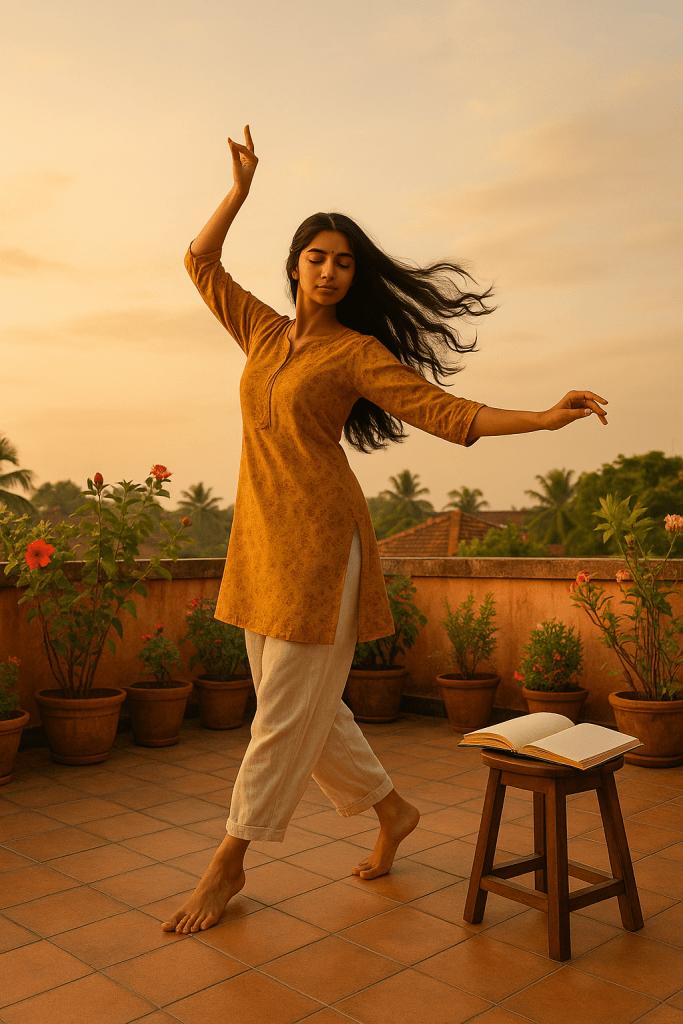
Jivika Menon, 28, moved like poetry across the floor—but her heart wasn’t in the rhythm anymore.
To the outside world, she was the heir to Menon Natyashala, one of the most reputed Bharatanatyam schools in southern India. People often referred to her as “Paati’s shadow,” inheritor of grace, discipline, and legacy. Inside her, though, there was a quiet ache. A restless hunger that grew with every sunset.
Her grandmother, Rajalakshmi Menon—fondly called Paati by all—had built the school from scratch. A single mother with a spine carved of fire and grit, she had turned her love for dance into an empire. In her eyes, tradition wasn’t just sacred—it was survival.
“You were born for this,” Paati had often said. “It runs in your blood, child.”
But what if it didn’t anymore?
By day, Jivika taught students the adavus, repeated chants, corrected mudras, and adjusted pleats. She could teach in her sleep—she often did, in dreams she didn’t enjoy. But by night, on the moss-lined terrace, she played indie tracks on low volume and choreographed wild, impulsive movements in her mind. Movements that didn’t ask permission. Movements that didn’t belong to any school or form. Unstructured. Untamed. Honest.
Her journal held the version of her no one had seen.
One night, under a flickering terrace bulb, she scribbled:
How do I tell them that I love dance… just not like this? That I want to mix the old and the new—not dilute, just evolve? That I want to teach kids who can’t even afford ghungroos, whose feet still know how to feel?
But her problems weren’t just artistic.
Her parents wanted her to marry—“someone who understands art,” they said, as if compatibility meant attending dance recitals and quoting Tagore. Her relatives whispered at weddings, eyes sharp with pity: “Still not married? She’s almost thirty!”
Every family gathering echoed the same rehearsed concern wrapped in sweet smiles:
“Still… dancing?”
To them, art wasn’t a career. It was an indulgence. A stepping stone to real life.
To Jivika, it was her only language.
She felt choked between applause and expectation. Adored by the outside world, she was slowly disappearing inside her own skin.
Then came the email.
From The Fifth Limb Collective, a contemporary dance troupe based in Pondicherry. They had seen her anonymous submission. A six-month residency that promised movement therapy, cultural collaborations, and the chance to teach children in local slums.
They offered her a spot.
She stared at the screen, numb.
She’d sent the audition clip on a dare—to herself. A raw piece she’d choreographed barefoot, wearing linen pants, moving to the sound of rain and silence. No costume. No music. No performance. Just the truth.
And someone had seen her.
But guilt came rushing in. Could she leave everything behind? The school, the legacy, her students, her Paati’s expectations?
She delayed telling anyone. Days passed in a blur of aching indecision.
Then, one evening, after a painfully orchestrated “future planning” meeting with her father and Paati, she broke.
“Paati, Appa, Amma… I’ve been offered a chance,” she said, standing, her voice steadier than she felt. “It’s a modern dance residency. It’s not disrespect. It’s… different. I want to go.”
The silence was cavernous.
“You’re turning your back on your roots?” her father said, almost in a whisper.
“This school gave you everything,” Paati murmured, her voice trembling more with sorrow than anger.
Jivika’s eyes burned. “I know. And I’ll always carry it with me. But I want to see what else I can become.”
The house was cold after that. Her mother avoided eye contact. Her father retreated into the pages of his paper. Paati didn’t come to watch her evening practice.
Then one morning, Paati walked into Jivika’s room holding an old photograph.
It was of her, young and fierce, dancing at a college fest in jeans and a cotton kurta—long before the Natyashala ever existed.
“I was like you once,” she said, voice softer than Jivika had ever heard. “Wild. Curious. Brave. Then I chose the path that felt right at the time. Maybe now… it’s your turn to choose.”
Jivika cried. And so did Paati.
In that quiet moment, no apologies were needed. No arguments, no convincing. Just two women from different times, bound by the same passion, finally seeing each other not as teacher and student, not as tradition and rebellion—but simply as dreamers.
The next morning, sunlight spilled into the hall as if blessing what was to come. Jivika packed her ghungroos alongside her journals, folded away sarees next to denim, and carried her grandmother’s blessing like a sacred thread around her soul.
And then—she left.
—
In Pondicherry, everything was different.
She danced on beaches at sunrise, barefoot in red earth. She taught little girls who couldn’t speak English but knew rhythm better than most. She collaborated with hip-hop dancers, Carnatic violinists, spoken word poets, and a mime from Senegal.
Her body relearned everything—and remembered everything.
Her soul bloomed.
She wasn’t abandoning tradition. She was carrying it forward, in her own voice.
Months passed like poetry. Then one day, while packing props for a local event, her grandmother called.
“The school misses you,” she said, her voice laced with teasing warmth.
“I miss it too.”
“Come back when you’re ready. The girls would love to learn what you’re learning.”
—
The video that changed everything came later.
Jivika stood in a sun-drenched courtyard, barefoot, hair loose, dancing to a poem about freedom in Tamil and English. The score blended tanpura with ambient street sounds and laughing children.
Her caption read:
“For every girl who was told, ‘good girls don’t do that.’”
It went viral.
When she returned to Alappuzha, she wasn’t the same.
And neither was the world around her.
Paati now hosted fusion workshops every month.
Her parents introduced her not as “our daughter the dancer,” but “our daughter the artist.”
And on the terrace, where she once danced alone, she now hosted a weekend class called Unlearn—for the children of housemaids, auto drivers, and laborers. They danced barefoot, without steps or rules, only rhythm and joy.
Every evening, Jivika still climbs the terrace.
She watches the sky shift, the backwaters gleam, the trees sway—and her soul breathes easy.
She’s still dancing.
But now, finally, she’s free.
—
The End


 Uththan
Leave a comment