Trigger Warning / Disclaimer

This story touches on themes of aging, grief, and emotional isolation. It explores intergenerational bonds and nostalgia in a deeply emotional but heart-warming way.

Reader discretion is advised.
The sky over suburban Bengal held the soft gray of an impending drizzle. Tapan sat on his rusting verandah chair, a shawl draped over his knees, flipping through an old album with half-closed eyes. His granddaughter, Zoya, all elbows and energy, burst out from the inside room, a dusty red notebook in her hand.
“Dadu! Look what I found behind the cupboard. It’s got your name!”
Tapan adjusted his glasses, squinting. “Ah, my cricket diary…”
“Your what?”
He smiled, lines folding at the corners of his eyes. “From when I was your age. We used to play cricket every monsoon, right behind the house. That meadow was our Eden Gardens.”
Zoya’s eyes widened. “You played? Were you famous?”
“Famous?” He chuckled. “We were legends—in our lane, at least. Every rainy season, barefoot and bruised, we’d make that meadow our world.”
Zoya flopped beside him. “Who were ‘we’?”
He tapped the diary. “Ah, there was Shibu, the angry spinner. Ratan, our eternal wicket-keeper. Munna with his swing that never swung. And me—Tapan the Terror, they called me.”
Zoya giggled. “Tapan the Terror? Really?”
“Oh yes,” he grinned. “I once hit six sixes in an over. Of course, it was against a bowler who was also holding a lollipop at the time, but it still counts.”
She laughed, eyes lighting up. “You should meet them again,” Zoya said. “You should play again.”
Tapan looked away, a shadow crossing his face. “That was a long time ago, shona. Everyone’s moved on. Jobs, families, surgeries… Ratan has a limp, Shibu barely talks to anyone, and Munna… I haven’t heard from him in years.”
“But why not? You’re always grumpy and bored. Maybe your friends are, too.”
He sighed, voice dropping to a whisper. “I don’t know if we’re the same people anymore.”
Zoya sat up straighter. “Maybe you’re not. But maybe that’s the point. You don’t have to be who you were—you just have to be with them.”
He looked at her then, really looked. She wasn’t just a child anymore. There was something solid in her—like her mother had been at that age. Kind eyes. Strong will.
“You sound like your Aji,” he murmured.
“I never met her,” she said softly. “But I think she left bits of herself in your stories.”
Tapan closed the diary, resting it against his chest. “You really want this old man to try and bowl again?”
She nodded. “Not just bowl. Remember.”
A long silence. Then Tapan chuckled. “God help my knees.”
—
The next morning, Zoya handed him a cup of tea and a piece of paper. On it were four neatly written names and phone numbers—some with question marks.
“I asked Ma to help. She remembered some of their surnames. You just have to call.”
Tapan stared at the paper like it was a fragile artifact. “I haven’t spoken to some of these fellows in thirty years. What am I supposed to say? ‘Hi, remember the guy who hit you in the face with a cover drive in 1987?’”
Zoya grinned. “Exactly.”
He rolled his eyes, but she saw the twitch of a smile. He folded the paper and slid it into his pocket.
—
The first call was to Ratan.
“Hello?” came the voice on the other end—older, raspier.
Tapan’s throat went dry. “Ratan? It’s Tapan.”
A beat.
“Tapan the Terror?” Ratan gasped. “I thought you were dead!”
“I get that a lot.”
Ratan laughed—a deep, hearty laugh that made Tapan’s eyes sting. “You still got that annoying laugh?” Tapan asked.
“Only when I’m nervous. Or happy. So, which is it now?”
They spoke for twenty minutes—about arthritis, grandchildren, retirement, and the one time Ratan dislocated his finger trying to catch Tapan’s top edge.
By the end, Ratan said, “You thinking what I think you’re thinking?”
“I want to play one last match. In the old meadow.”
Ratan was quiet, then: “Count me in. If I can still find my left leg.”
—
One by one, the calls were made. Shibu was living alone in Shantiniketan, teaching children how to bowl off-spin with socks. He was hesitant, distant at first, until Tapan reminded him of the time they won a mango from the village headman by taking down his team of smug teenagers.
Shibu laughed, and then said, “I haven’t touched a ball in years. But for you, I’ll try. Just don’t make me run.”
Munna was the hardest to find. He’d moved to Pune, remarried, and was no longer in touch with many from the past. But when Tapan finally heard his voice—low, uncertain—something in his chest eased.
“You sure they’ll want to see me?” Munna asked.
“They don’t just want to see you. They need to,” Tapan said. “We all do.”
—
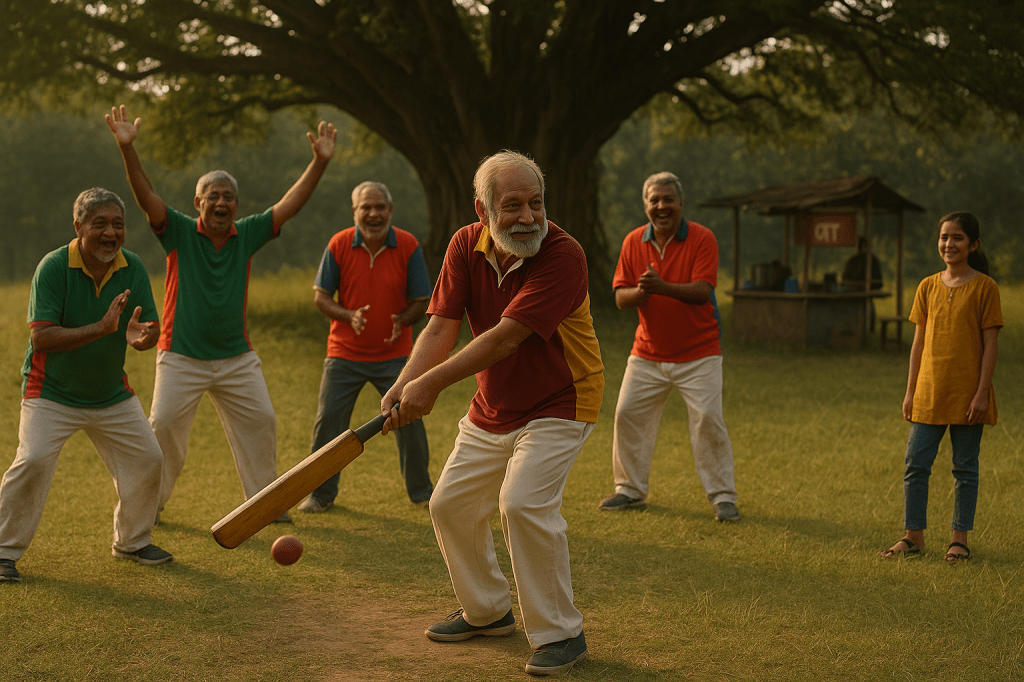
Zoya arranged the game for a Sunday morning. The meadow behind the house—overgrown, wild, and sun-soaked—was cleaned up with help from local boys. Stumps were fashioned from old tree branches. A makeshift pitch was marked with white chalk powder. Even the neighbourhood chaiwala agreed to set up shop near the banyan tree.
Tapan stood in his old jersey—faded, tight around the stomach—and looked at his reflection in the window.
“Not bad for a nearly-dead man,” he muttered.
Zoya popped in. “Don’t forget your ankle guard.”
“I’m not that old.”
“You literally groaned when you sat down yesterday.”
He tried to glare at her, but she was already skipping down the stairs.
—
By 10 a.m., they had all arrived.
Shibu, balding but with the same fire in his eyes. Ratan, walking with a stick but laughing louder than ever. Munna, quiet, holding a cricket ball like it was sacred.
They embraced like boys, slapped each other’s backs, teased about bellies and broken knees.
Zoya, watching from the sidelines, felt a strange warmth. These weren’t just old men playing cricket. They were trying to find a part of themselves they thought they’d lost.
The match began with Ratan bowling to Tapan. The first ball was wide. The second clipped the stumps.
“Still rubbish,” Ratan shouted.
Tapan pointed his bat. “I slipped.”
They laughed. Loud, free, unashamed.
—
Midway through the game, the jokes slowed. They sat under the banyan tree, sipping chai, breath catching not just from exertion but from memory.
“I never said sorry,” Shibu said quietly. “That last match… when I walked out. I was angry. But it wasn’t your fault.”
Tapan nodded. “I could’ve stopped you. I was too proud.”
Munna looked at them both. “We all were. Maybe we still are.”
Ratan leaned back, eyes closed. “But look at us. Still here. Still playing. Maybe that’s enough.”
Zoya joined them, offering water. “Not just playing. Healing.”
Tapan looked at her and smiled.
—
By the end of the match, no one remembered the score. But everyone remembered the laughter, the apologies, the stories retold like holy scriptures.
As the sun dipped low, the old gang sat in a line, looking out at the field.
“It’s not the same meadow,” Munna said.
“No,” Tapan replied. “But maybe we’re not the same boys either. And that’s okay.”
Zoya came up from behind, holding a Polaroid camera. “Smile, legends.”
The shutter clicked.
A photo caught them mid-laugh—wrinkled, tired, joyful.
—
That night, Tapan sat on his bed, the photo in his hand, the diary beside him.
Zoya peeked in. “Tired?”
“No,” he said. “Full.”
She sat beside him.
“You gave me back something I didn’t know I missed,” he said. “Thank you.”
She rested her head on his shoulder. “I didn’t just want to meet your friends. I wanted you to meet yourself again.”
And in the silence that followed, Tapan realized he had.
Not the cricketer. Not the terror. Just a man who once played under the monsoon sky and found his way back through friendship.
—
The End



 Uththan
Leave a comment