
Trigger Warning / Disclaimer

This story contains references to anxiety, panic attacks, emotional burnout, and threats related to legal and professional pressures. If you are struggling, please consider reaching out to a mental health professional—you are not alone.

Reader discretion is advised. If you find such themes triggering, please proceed with caution.
The glass walls of the courtroom seemed to close in as Devika clutched the edge of the podium. Her breath came in shallow bursts. The judge’s voice blurred into a static hum, and though the opposing counsel was still arguing passionately, she couldn’t make out a single word. Her fingers trembled as she reached for the water glass and missed it. She didn’t faint, but she wanted to. The panic attack hit her like a silent wave—unseen, unannounced, unrelenting. But it wasn’t the first. It had been building, whispering in the corners of her mind, waiting to swallow her whole. Ever since she took on the Khanna case.
Khanna was no ordinary client. A high-profile builder accused of illegally demolishing low-income homes, leaving dozens of families displaced and unheard. Devika had taken the case on principle, determined to stand for the voiceless.
But within days, the threats began. First, an envelope slid under her office door with a typed note: “Withdraw, or your silence will cost more than your words ever could.” Then came a phone call, chilling in its simplicity: “Drop the case, or we’ll drop something heavier on you.” Her firm arranged for extra security.
The police filed a report. But no protection could shield her from the fear that had already burrowed beneath her skin. And beneath that fear, guilt—guilt for not being unshakable, guilt for slipping, for showing cracks when she had always been the composed one.
She stopped sleeping properly. Started skipping meals. Her office, once organized and pristine, became a mess of paper stacks and coffee cups. She yelled at juniors for minor mistakes and ignored texts from Shubham, her fiancé, until unread messages became days of silence. And now, she was unraveling under the fluorescent lights of a courtroom she once commanded like a stage.
That night, curled on the sofa in an oversized hoodie, she finally let herself cry. Shubham came home late with dinner—simple dal-chawal, her comfort food. He didn’t speak at first, just placed the tray gently on the table and sat beside her. She didn’t look at him, but she could feel his presence, quiet and grounding. “I think I’m broken,” she whispered eventually, her voice dry and cracked.

He didn’t flinch. “You’re not,” he said softly. “You’re tired. You’ve been carrying too much for too long. Let it fall.”
She looked at him then, eyes wide and brimming. “I’ve pushed you away.”
“I know,” he said. “And I stayed anyway.”
—
Instead of fleeing to a far-off town, Devika made a different choice. She stayed. But she paused.
The next morning, Shunham made her tea and sat beside her on the balcony.
“You need help, Dev,” he said softly. “And not the kind you file in court. The kind where you let people in.”
She looked away. “I can’t afford to fall apart. Not now. Not when I’m supposed to be the one holding everything together.”
“But what if holding it together is exactly what’s breaking you?”
He reached out, took her hand. “Let’s talk to Ma. Let’s talk to the firm. You don’t have to do this alone.”
So, Devika took a two-week leave, not to run—but to realign.
Her mother, Rekha, surprised her by not arguing.
“I know you think I expect you to be strong all the time,” Rekha said one evening as they made dinner. “But being strong doesn’t mean being silent. It means being honest.”
Devika stirred the dal absently. “Sometimes I feel like if I say it out loud, it’ll make it more real. The fear. The shame. The guilt.”
Rekha touched her arm. “It’s already real, beta. The only way out is through.”
—
Her closest friends dropped by one evening with biryani and mango ice cream.
“You’re not superhuman,” her friend Ananya said, giving her a tight hug. “You’re allowed to take a breath. Even superheroes have downtime.”
Another friend, Mehul, added, “Remember that property case you helped me with? I was a mess. You didn’t judge me. So don’t judge yourself.”
Devika smiled, tears welling up. “I thought you all would think I’m weak.”
“Devika Rao? Weak?” Mehul laughed. “Please. You’re the strongest person we know. But strength doesn’t mean you never cry.”
—
In those two weeks, Devika saw a therapist regularly.
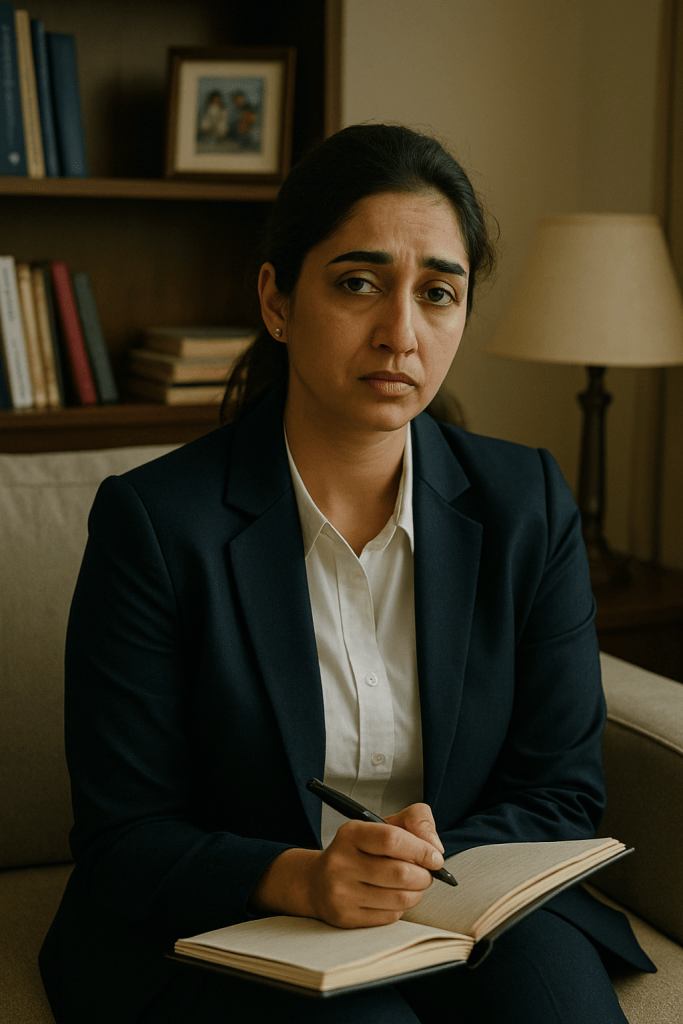
Dr. Iyer was a calm presence with a thoughtful face. “I can’t breathe when I walk into court,” Devika admitted, fingers picking at a loose thread on her sleeve. “I used to feel powerful there. Now I feel… hunted.”
Dr. Iyer studied her for a moment. “What’s more frightening to you—the threats, or not being in control?”
The question sat with her, cold and real. “Both,” she whispered. And that was the truth. The loss of control rattled her more than the threats. She had built a life around being flawless—sharp, strong, unshakeable. To admit that she was human felt like betrayal.
The next few days were a blur of adjustment.
Her mother showed up with homemade pickles and a concerned scowl. “You look like you haven’t slept in years,” she muttered, sitting down heavily. Devika managed a weak smile. “It’s been weeks, not years.” Her mother paused, eyes softening. “Are you still working on that builder case? The one that’s been all over the papers?”
“Yes,” she said. “But it’s not just that. I’m… I’m losing myself in it.”
Her mother looked at her in silence for a long moment. Then, quietly, she said, “Your Aaji used to tell me, clarity doesn’t come when you conquer the mountain. It comes when you sit long enough at its base.” Devika didn’t reply. But for the first time, she felt the urge to stop climbing.
The healing didn’t happen all at once. Her friend Aruna from law school sent her silly memes and voice notes full of encouragement.
Her junior associate Sameera dropped by with modaks and whispered, “Ma’am, we look up to you—not because you’re perfect, but because you fight. Even now.” Her senior partner, Mr. Sharma, quietly reassigned some of her work without making a big deal out of it.
She spoke to him as he had taken over the Khanna case temporarily.
“And, are you doing okay with it?” she asked.
“Trying. But I gotta say, that builder’s team is nasty. You weren’t overreacting.”
Devika exhaled slowly. “Thanks for saying that.”
—
Slowly, Devika began returning to herself. Not the pristine version who crushed arguments in court, but the version who asked for help, who admitted she was struggling.
One afternoon, she walked into a local community legal clinic—not to volunteer, not yet. Just to see.
But one woman came forward, then another, and before she knew it, Devika found herself offering guidance—on land disputes, dowry harassment, child custody. There were no cameras. No pressure. Just her and her words, and the people who needed them.
That evening, she looked at herself in the mirror and didn’t see a failure. She saw someone in recovery. Someone learning to breathe again. She looked at herself and whispered, “I’m not broken. I’m just human.”
—
When Devika returned to work, she didn’t pretend.
She spoke to her team about boundaries, about burnout, about safety protocols for high-risk cases. She asked for help when she needed it. She laughed more. She even cried once, during a pro bono case with a domestic abuse survivor.
And she didn’t apologize for it.
When the Khanna case resumed, she walked into court with her shoulders a little straighter. The threats hadn’t stopped completely. But neither had her resolve. The fear was still there, humming beneath her ribs—but now it had company: courage. Compassion. Clarity. She carried them like armor.
After a long day, she passed by a small temple near her office. It was quiet, almost hidden between two modern buildings. She paused at the gate. For once, she walked in. No ceremony. No prayers. She stood before the brass bell that hung loosely from a wooden frame. She closed her eyes. Breathed.
Clarity didn’t arrive like a revelation. It crept in softly, day by day, moment by moment, through therapy, through family, through love, through kindness, through truth. And maybe that was the point.
Because sometimes clarity isn’t found in grand escapes or distant retreats.
Sometimes, it’s built in the middle of everything—right there, in the mess, the noise, the rush of life—and in the people who remind you that you are never alone.
—
One late evening, Shunham found her sitting in their living room, wrapped in a shawl, sipping ginger tea.
“What are you thinking about?” he asked.
She smiled, looking out the window.
“About how clarity isn’t something you find far away, on a mountain or in a temple. It’s in your kitchen. In your people. In your willingness to be seen.”
Shunham leaned closer. “So… you found your beacon?”
She nodded. “Yes. And it was never out there. It was right here. I thought I had to escape to understand. But my beacon is our family, you and our wonderful and supporting friends”
—
The End






 Uththan
Leave a comment