
Trigger Warning / Disclaimer

This story contains sensitive themes including depression, miscarriage, suicidal thoughts, and emotional trauma. Reader discretion is advised. While the narrative aims to portray healing and hope, it also delves into raw and painful emotional experiences. If you are struggling, please consider reaching out to a mental health professional—you are not alone.

Reader discretion is advised. If you find such themes triggering, please proceed with caution.
The ceiling fan made a soft, circular hum as Yashika sat on the edge of her bed, staring at the half-written message on her phone screen.
“Papa, I’m sorry I haven’t… I just…”
She deleted it again. For the fifteenth time.
The screen blurred as tears welled up. She pressed her forehead to her knees, fists clenched. Why did even texting feel so impossible?
The door creaked open.
Viaan walked in, his face pale, eyes rimmed with sleeplessness. He was holding her favorite tea—but it had gone cold in his hands. He placed it quietly on the side table.
He looked at her, his jaw tightening, trying to be strong. But he wasn’t.
“Yashika, you have to talk to him.”
“I can’t,” she whispered. “I’ll break. And if he sees me like this…”
Some days, it wasn’t even sadness—it was nothing. A black, heavy fog that pressed on her chest, weighed her down, made simple things like brushing her hair or replying to a text feel impossible. The world kept asking her to move, speak, and smile. And she wanted to. God, she wanted to. But her body didn’t always cooperate.
She remembered the worst night—barely a month ago.
She had woken up at 2:37 a.m., hands trembling, throat choking on her own breath. She stumbled to the bathroom and locked the door, curling on the cold tiles, crying soundlessly, scratching her arms just to feel something. Her screams were trapped in her throat. She had stared at the mirror and whispered, “I can’t do this anymore.”
Viaan had knocked gently. Then harder. And finally broken the door open. He didn’t scold her. He just picked her up like she was made of glass and sat with her in the bathtub, letting the shower run cold on both of them until her body stopped shaking.
“I’m not angry with you,” he had whispered. “I just want you to stay.”
That night, he had booked a therapy appointment. Held her while she slept. Cancelled work the next day. And bought her the exact same stuffed elephant she used to keep by her pillow as a kid.
But no one in her family knew.
Especially not Papa.
She used to be his brave girl. The one who fought bullies in school. The one who stood up to society and chose her own career, her own husband. The one who debated with him on politics over dinner. The one he proudly told everyone about.
And now? She felt like a shell of that person.
Papa had stopped calling after the sixth time she canceled their visit. He’d said, “It’s okay, I know you’re busy.” But his voice had cracked, ever so slightly.
And then silence.
Until Amma called with the news.
“His heart’s not doing well. But more than that, it’s you, Yashika. He thinks you’ve forgotten him.”
Yashika had cried silently, curled up in the blanket, while Viaan rubbed her back.
“How do I tell him?” she asked. “How do I tell Papa that his strong daughter… is broken?”
“By trusting that he’ll still love you,” Viaan whispered. “Maybe more than before.”
Viaan slumped to the floor beside her, leaning his head back against the wall. His chest rose and fell in shallow breaths.
“I’m scared too,” he said, almost inaudibly.
She looked at him. His eyes were glassy now.
“You think it’s been hard for you, and it has. But do you know what it’s like to watch you slip away and not be able to pull you back?”
Tears spilled silently down his face.
“Do you know how many times I’ve stood outside the bathroom door, praying I wouldn’t hear silence?”
Yashika’s lips trembled.
“Do you know I’ve called your brother at 3 a.m. just to ask how you used to laugh as a child?”
Her breath caught in her throat.
“I’m not saying this to make you feel guilty,” he added. “I’m just… exhausted, Yashika. Not of you. Never of you. Just… of the fear. Of losing you without ever getting to say goodbye.”
She broke. Crawled toward him and held him tightly as both of them wept together. The silence wasn’t heavy anymore—it cracked, it shattered, and it spilled years of pain onto the floor between them.
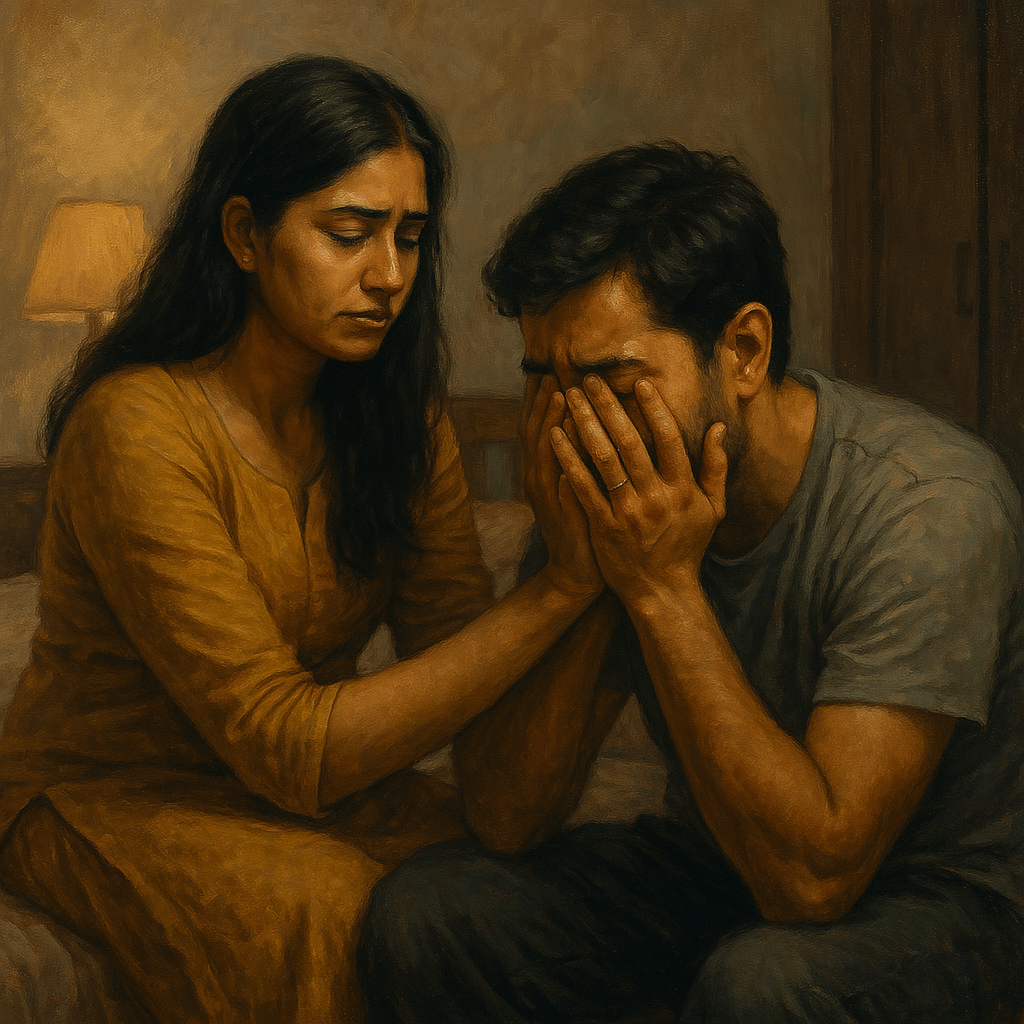
After a long pause, he pulled her back gently, cupping her face.
“Go home. See him. Let him see you—flawed, fragile, healing. Let him know the truth.”
She looked down, unsure.
“Don’t do it for him,” Viaan whispered. “Do it for the little girl who used to run into his arms when she scraped her knee. She still needs him.”
—
And so, on a humid Saturday morning, Yashika stood in front of her childhood home. The paint had faded a little, the plants on the balcony were overgrown, but it still smelled like home—haldi, incense, and the faint sweetness of coconut oil.
The gate still creaked the same way.
And as she stood frozen, unsure of whether her feet could move forward, a voice broke her spiral.
“Didi?”
It was Aarav, her younger brother. Taller now. His beard had grown. But his eyes still held the same warmth.
“I saw your name on the intercom log,” he said, gently. “I figured I’d catch you before you ran back.”
She smiled weakly. “I thought you were in Pune.”
“I was. I came when Amma told me everything.” His voice was calm. Not accusing. Just… present.
Yashika blinked, confused. “Everything?”
He nodded. “Viaan called. Said you needed your brother back.”
She swallowed hard.
Aarav hesitated. Then said softly, “I used to be angry. You disappeared. You didn’t reply to messages. But then I saw how thin you looked in Amma’s Diwali photos. I saw your smile—how it didn’t reach your eyes. And I remembered the sister who used to fight monsters under my bed.”
She laughed through her tears. “I don’t even know where to begin.”
“Try with ‘hi’.”
“Hi,” she whispered.
“Welcome home,” he replied, wrapping her in a warm, crushing hug.
And for a moment everything was calm in her world.
—
She rang the bell.
It was Amma who opened the door. She didn’t say anything. She just pulled Yashika into a long, quiet hug. The kind that makes you remember who you are.
“Where is he?” Yashika asked, her voice barely above a whisper.
Amma pointed to the terrace.
“He goes there every morning now. Says the city looks softer from up there.”
She walked in.
Up the stairs.
To the terrace. Her hands trembled slightly as she pushed open the terrace door.
And when she saw him, she froze. His back hunched slightly. His hair whiter than she remembered. His hands fumbled to change the radio station.
Her father sat on a plastic chair, a small radio beside him playing an old Kishore Kumar song. His frame looked smaller. The lines on his face deeper. But his eyes, when they met hers, still held that same stubborn warmth.
“Hi, Papa,” she said.
He blinked. Then looked away.
“Tch. You came without calling. I would’ve made your favorite tea.”
“I didn’t want you to say no.”
He didn’t respond.
She walked closer and sat on the floor beside him.
He didn’t respond.
She sat on the floor beside him.
“I wasn’t okay, Papa,” she said, the words coming slower now. “Actually, I’m still not.”
He looked at her, confused.
“I’ve had… three miscarriages. I didn’t know how to tell anyone. I didn’t want pity. And then came the silence. The… fog.”
He was staring now. Not speaking. But listening.
“I stopped feeling like myself. I couldn’t cook. Or laugh. Or talk to anyone. Viaan has been carrying me—literally, some days. I didn’t pick your calls because I was scared you’d hear the weakness in my voice. That you’d think your daughter failed.”
“Failed?” His voice was brittle, like thin glass.
“I felt like I failed as a woman. As a daughter. As a human being.”
She broke then. Completely. Weeping, heaving, her voice cracking.
“I used to look at knives in the kitchen and wonder if it would be easier to stop everything. I used to hold my stomach and apologize to the child who never came. I would wake up gasping, thinking maybe this time it will all be a bad dream. And every time I looked at my phone, I wanted to call you. But I just… couldn’t. I thought you’d stop loving me if you saw me like this.”

Papa didn’t speak. He didn’t move.
Then, slowly, shakily, he stood and knelt beside her.
“Yashika,” he said, voice shaking. “You think I love you because you were strong? Brave? No. I love you because you are mine. Even in your weakest, even when you’re hurting, even when you’re lost.”
He held her face between his weathered hands.
“You don’t have to be whole for me to hold you.”
And then he did. He held her like he used to when she was a child who had scraped her knees. As if she had never grown up. As if time and pain hadn’t layered between them.
Downstairs, Amma stood at the kitchen doorway, watching through the window with tears in her eyes. Viaan stood beside her, his hand clutching the phone he never used. He had just wanted to make sure she was okay. But when he saw her cry freely in her father’s arms, he put it away.
“She’s found her way,” Amma said softly.
“No,” Viaan whispered, watching the woman he loved. “She’s finding it.”
That night, they all sat on the floor—Amma, Papa, Aarav, Viaan, and Yashika.
There were no big declarations. No overdone words. Just food passed around, soft laughter, and glances filled with quiet relief.
Yashika looked around and exhaled.
The healing hadn’t finished. But it had begun.
The stream had found its way back—cutting through stones of silence, carving space in walls built by pain.
And maybe, just maybe, this was how reconciliation worked.
Not all at once.
But slowly. Gently. Like water.
—
The End






 Uththan
Leave a comment