Trigger Warning / Disclaimer

This story contains themes of ego, arrogance, and personal growth. It portrays intense competition, moments of failure, and emotional conflict. While the story highlights the journey of learning humility, some readers may find the protagonist’s initial behavior frustrating. This is a work of fiction set in a culinary competition and does not intend to disrespect any cuisine, tradition, or profession.

Reader discretion is advised. If you find such themes triggering, please proceed with caution.
Jaipur had no shortage of food. From street-side stalls sizzling with mirchi vadas to fine-dining establishments serving royal thalis, the Pink City was a feast in itself. And in the heart of this culinary battlefield stood Raghav Malhotra, a name that dominated social media feeds and food blogs.
A viral sensation, Raghav had built his brand on sharp plating skills, dramatic flair, and an attitude that split his followers into two camps—those who worshipped him and those who couldn’t stand his arrogance.
At just 27, he had conquered Instagram, YouTube, and every major food festival that mattered. But for him, that wasn’t enough. He didn’t just want to be a chef. He wanted to be the chef.
So when The Royal Cook-Off announced its return—Jaipur’s most prestigious culinary competition, judged by actual royal descendants and traditional chefs—Raghav saw it as a mere formality. A stepping stone. Another title to add to his growing list of achievements.
“Pura Rajasthan mujhe already jaanta hai,” he had scoffed in an interview. “Winning this will just make it official.”
With millions of followers and a reputation that stretched beyond Jaipur’s city limits, Raghav Malhotra was certain of his victory. In his mind, the competition wasn’t about proving himself—it was about proving what everyone already knew.
But what he didn’t realize was that his biggest challenge wasn’t in the kitchen.
It was within himself.
And as he stepped into the haveli where The Royal Cook-Off was set to unfold, the weight of the occasion finally hit him.
The event was grand, a spectacle of culinary prestige, hosted in a heritage haveli that once served as a royal banquet hall. The scent of saffron and slow-cooked spices lingered in the air, blending with the grandeur of marble pillars, intricate Rajasthani frescoes, and golden chandeliers that shimmered under the evening lights. Cameras were everywhere—national TV, food bloggers, local news channels—all eager to capture Jaipur’s finest talents.
Raghav walked in, oozing confidence, dressed in a sleek black chef’s jacket embroidered with his initials. The other contestants? Forgettable.
At least, that’s what he thought.
Then he met Rajveer Rathore.
A man in his late 40s, clad in a simple kurta and apron, Rajveer had no flashy social media presence, no viral videos. What he did have was lineage. The Rathore family had served the royal kitchens of Jaipur for generations.
“Aap Raghav ho, na?” (You are Raghav, right?) Rajveer greeted him with a polite nod. “I’ve heard a lot about you.”
“Likewise,” Raghav smirked. “You’re that traditional chef everyone keeps talking about. Bahut suna hai aapke bare mein… dekhte hain, taste kaisa hai.” (I have heard a lot about you… let’s see if your work lives up to the hype)
Rajveer merely smiled, unfazed.
“Food isn’t just about taste, beta. It’s about respect.”
Raghav chuckled. “Respect doesn’t get views. Skills do.”
Rajveer’s eyes twinkled with amusement. “Then let’s see whose skills speak louder.”
—
The competition hall buzzed with energy, a mix of excitement and tension hanging in the air. Contestants rushed to their stations as the host announced the first challenge:
“Your task is to craft a dish inspired by Rajasthan’s royal culinary heritage. A dish that doesn’t just impress—but tells a story.”
The panel of judges was seated at a grand table, draped in regal blue and gold. Among them sat Maharani Devika, a poised woman in her late fifties, her presence alone enough to command respect. Alongside her were Chef Aman Mehta, a Michelin-starred expert in traditional Indian cuisine, and Chef Zara Khan, a culinary influencer with a flair for modern fusion dishes.
Raghav smirked as he stepped up to the pantry, rolling his shoulders. The competition wasn’t just about cooking—it was about winning. And if there was one thing he was certain of, it was that he belonged at the top.
His fingers skimmed over the selection of ingredients. Saffron. Black truffle. Aged parmesan. Imported olive oil. His mind raced as he envisioned his dish—Truffle-infused Dal Baati Churma with Parmesan Foam.
“Perfect.”
He turned slightly and caught sight of Rajveer, one of his competitors. Unlike Raghav, who exuded confidence, Rajveer moved deliberately, taking his time. He selected bajra, homemade ghee, and hand-ground masalas—humble, earthy ingredients.
Raghav chuckled under his breath. What is he making, prasad?
The clock started. 60 minutes.
—
Raghav worked with precision, his hands moving in fluid motions as he caramelized onions, blended his saffron-infused truffle oil, and foamed the parmesan. Every element of his dish was designed to be visually stunning—perfect for the cameras, perfect for his brand.
Meanwhile, Rajveer cooked slowly, pounding the bajra himself instead of using a processor. The fragrance of roasted grains and ghee began to fill the air, warm and comforting.
The judges walked around, observing.
Chef Aman stopped by Raghav’s station, peering at his technique.
“Interesting choice. Truffle in a Rajasthani dish?” he mused.
Raghav grinned. “Why not? Evolution is important. Rajasthan deserves to be on the global map, and this is how we do it.”
Chef Aman nodded, though his expression remained unreadable.
At Rajveer’s station, Maharani Devika watched as he poured melted ghee over the freshly pounded bajra khichdi. The scent made her pause.
“You made this by hand?” she asked, intrigued.
“Yes, Maharani Sahiba,” Rajveer said with a polite nod. “That’s how my grandmother made it. She said the taste changes when you grind the grains yourself.”
Maharani Devika smiled faintly, something unreadable in her eyes.
—
Time was up.
Raghav stepped back from his station, admiring his plate. The Dal Baati Churma was plated with artistic precision—golden baatis sitting atop a bed of truffle-infused dal, finished with an airy parmesan foam. A masterpiece.
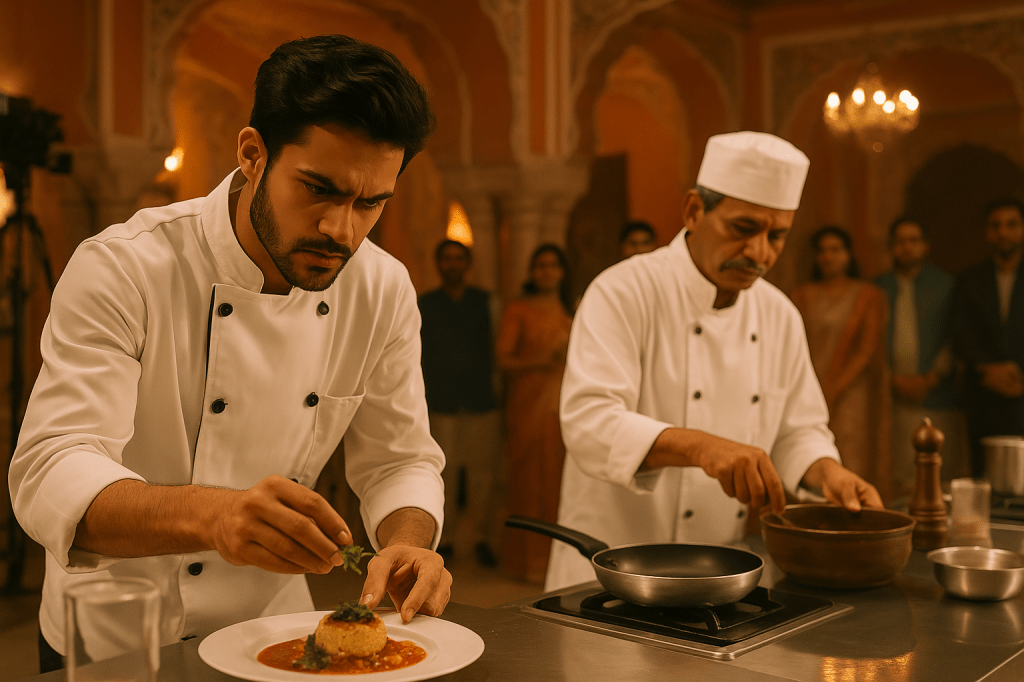
Rajveer’s plate was far simpler—just a bowl of hand-pounded Bajra Khichdi, glistening with a generous drizzle of pure desi ghee. No garnishes. No theatrics.
The judges began tasting.
Raghav’s dish was first.
Chef Zara took a bite and raised her brows. “This is… bold.”
Chef Aman nodded. “Flavors are well-balanced. But…” He hesitated before adding, “It’s innovative, yes, but does it still carry the essence of what Dal Baati Churma is?”
Raghav stiffened. What kind of question is that?
Then, they moved to Rajveer’s dish.
Maharani Devika took a bite.
And paused.
A long, quiet pause.
She closed her eyes, as if transported somewhere else. When she finally spoke, her voice was softer.
“This… reminds me of my childhood.”
A single sentence. But it carried more weight than a thousand social media likes.
Chef Aman took another spoonful. Chef Zara nodded slowly. There was something undeniably authentic about Rajveer’s dish. It wasn’t flashy. It wasn’t modern.
It was just… real.
Raghav felt a cold knot form in his stomach. He knew his dish was technically superior. So why did it feel like something so basic had overshadowed his masterpiece?
He didn’t have the answer.
Not yet.
The applause had barely faded, but Raghav felt a sharp sting beneath his confidence. He masked it with a smirk, clapping along with the others as Rajveer’s dish earned murmurs of admiration.
“One round doesn’t decide the winner,” he reminded himself. There was still time.
The host stepped forward, excitement in his voice.
“Contestants, are you ready for your next challenge?”
The screen behind them flickered to life. A sentence appeared.
“The Taste of Home.”
The crowd whispered. The theme was deceptively simple. A dish that evoked home. Comfort. Identity.
Raghav exhaled through his nose. Home? His mother’s face flashed in his mind. She was a great cook, but he had spent most of his childhood pushing away from home-cooked meals, always drawn to global flavors, to fine dining.
Meanwhile, Rajveer straightened, a quiet confidence settling over him. Raghav noticed it and hated the way it made his chest tighten.
The timer started. 90 minutes.
Raghav moved fast, running his fingers through his hair as he tried to define home. What was comforting? What was nostalgic?
He decided on a modern take on Aloo Pyaaz Ki Kachori—a Jaipur street food staple—but instead of deep-frying, he air-fried it, paired with a saffron-infused sweet chutney and a spiced avocado yogurt dip.
“This is how street food should be presented,” he thought, rolling out the dough with precision.
Across from him, Rajveer was working on something far simpler—Gatte Ki Sabzi with hand-kneaded wheat rotis. His movements were unhurried, as if he could hear something the others couldn’t.
At one point, Maharani Devika passed by and asked, “Why this dish?”
Rajveer smiled. “Because this is what my mother makes every time I visit home.”
Raghav heard that and scoffed internally. A home dish? This isn’t a family dinner, this is a contest.
—
The 90 minutes ended.
Raghav’s dish looked like it belonged in a Michelin-star restaurant—his kachoris were crispy, light, plated with delicate garnishes. It was perfect for a food magazine cover.
Rajveer’s plate? A simple bowl of Gatte Ki Sabzi, steam rising, with soft rotis stacked beside it. No drama. No theatrics.
The judges started with Raghav.
Chef Zara dipped a kachori into his saffron chutney and took a bite. “This is… unexpected.”
Chef Aman chewed thoughtfully. “You’ve elevated it, no doubt. But have you made it better, or just different?”
Raghav’s stomach tightened. Again? This same sentimental nonsense?
Then, they tasted Rajveer’s dish.
Maharani Devika took a single bite and suddenly stopped.
A hush fell over the room.
She swallowed, then exhaled. “This is home.”
Chef Aman nodded slowly. “This is what comfort tastes like.”
Chef Zara, usually chatty, simply closed her eyes for a moment, before murmuring, “Beautiful.”
The crowd clapped. Some even cheered softly.
Raghav felt something break inside him.
It was happening again.
His dish was technically flawless, but it wasn’t felt.
Rajveer had done it again—not with complexity, but with emotion.
And this time, Raghav didn’t even try to smile.
For the first time in his career, he felt small.
—
That night, Raghav didn’t celebrate. He didn’t scroll through Instagram. He didn’t even look at the articles that were already writing about the competition.
Instead, he sat in his hotel room, staring at his hands.
Why wasn’t it enough?
He had spent years perfecting his craft, pushing himself beyond tradition. He had cooked in Paris, in Dubai, in London. He had trained under international chefs.
And yet, two bowls of simple food had outshined him.
For the first time, he felt something that scared him.
Doubt.
—
The next morning, the contestants were gathered for the final round. The challenge was simple.
“A dish that represents you.”
Raghav’s breath caught in his throat.
He knew what to do. He needed to prove his worth—to silence every voice that said his food lacked heart. He would go bigger, grander, bolder than ever before.
But as he looked around, he saw Rajveer, standing calmly, rolling out dough for something simple.
And for the first time, Raghav asked himself:
What if the problem isn’t the food?
What if the problem is… me?
The kitchen buzzed with frantic energy as the contestants set to work. Cameras zoomed in, capturing every motion—the slicing of vegetables, the crackling of spices hitting the pan, the intensity in the chefs’ eyes.
For Raghav, this round was do-or-die.
“A dish that represents you.”
He needed something powerful. Something that screamed Raghav Malhotra.
He thought about his culinary journey—the fusion techniques, the foreign influences, the viral fame. His mind raced.
What am I known for?
Then it hit him.
He would create a Deconstructed Rajasthani Thali—a modern, plated version of Rajasthan’s most iconic dishes, transformed into fine-dining elements.
He worked like a man possessed.
- Dal Baati Churma—reimagined as a delicate espuma, served in a tiny ceramic cup.
- Laal Maas—seared mutton medallions, drizzled with a reduced saffron-infused jus.
- Ker Sangri—turned into a microgreen salad with edible gold flakes.
- Mawa Kachori—but presented as a bite-sized soufflé with a liquid saffron center.
It was flawless. Perfect. A reflection of his culinary style—bold, experimental, sophisticated.
Across the room, Rajveer worked quietly.
He wasn’t deconstructing anything.
He was making his mother’s recipe for Laal Maas.
Traditional. Rich. The kind of food meant to be eaten with your hands, not tiny plated forks.
Raghav saw this and nearly laughed.
“You’re making home food? In the final round?”
Rajveer didn’t answer. He just kept cooking.
—
The contestants stepped back. The dishes were placed in front of the judges, side by side.
The contrast was stark.
Raghav’s plate looked like something out of a five-star tasting menu. Artful, elegant, precise.
Rajveer’s dish? A rustic, steaming bowl of Laal Maas, served with thick, hot Bajra Rotis.

The judges started with Raghav’s dish.
Chef Aman took a bite, nodding in approval. “Technically brilliant.”
Maharani Devika observed it closely, tasting each element. “It’s visually stunning, but…” She hesitated.
Chef Zara frowned slightly. “It’s missing something.”
Raghav’s stomach dropped.
Missing what?
Then they tasted Rajveer’s dish.
Maharani Devika took one bite and stilled.
Chef Aman exhaled slowly.
Chef Zara set her spoon down, her expression softening.
Maharani Devika spoke first. “This… this is Laal Maas the way my grandmother used to make it. This is soul food.”
Chef Aman leaned back, shaking his head in admiration. “You didn’t just cook. You honored something bigger than yourself.”
Raghav gritted his teeth. Again. Again, the same reaction.
He felt something tighten in his chest.
And then, the final verdict.
The host cleared his throat. “And the winner of The Royal Cook-Off is…”
A pause.
“Rajveer Rathore!”
The room exploded in cheers.
Raghav froze.
His vision blurred slightly as Rajveer was lifted onto the stage, the trophy handed to him.
Raghav’s hands clenched into fists. He forced himself to keep a straight face, to nod politely, to shake hands when people turned to him.
But inside, something cracked.
—
Raghav left the venue as soon as he could.
The cheers, the flashing cameras, the murmurs of admiration for Rajveer—it all became unbearable.
He walked through the dark streets of Jaipur, his mind replaying everything.
He had come into this competition believing he was untouchable. A star.
Instead, he had been humbled.
Badly.
His food was flawless, but it lacked heart. His talent was undeniable, but his arrogance had blinded him.
And Rajveer…
Rajveer had cooked with his soul. And people felt it.
For the first time in his career, Raghav wondered if technique alone was enough.
Or if he had spent so much time trying to impress… that he forgot why he started cooking in the first place.
—
A week later, Raghav sat at his mother’s dining table.
For the first time in years, he wasn’t in a high-end kitchen.
He wasn’t being filmed. He wasn’t trying to create something for a viral post.
He was just eating.
His mother placed a bowl of Dal Baati Churma in front of him, the same way she had done for years.
“Try it,” she said with a smile.
He picked up a piece of Baati with his hands, dipped it into the dal, and took a bite.
The flavors hit him—deep, familiar, warm.
For the first time, he understood.
Food wasn’t about innovation. It wasn’t about perfection.
It was about connection.
And in that moment, Raghav Malhotra—the viral chef, the ego-driven perfectionist—finally learned humility.
—
The End



 Uththan
Leave a comment