Trigger Warning / Disclaimer

This story explores themes of heartbreak, emotional healing, and self-discovery. It delves into feelings of loneliness, past regrets, and unresolved emotions. While the narrative focuses on growth and resilience, readers who are sensitive to themes of emotional pain and introspection may find certain moments intense. Reader discretion is advised.

Reader discretion is advised. If you find such themes triggering, please proceed with caution.
The mountain air was crisp, carrying the scent of pine and damp earth. Vaidehi tightened her shawl around her shoulders as she walked down the narrow, winding trail, her boots crunching against scattered pine needles. The town was quiet this morning, with only the distant clang of a temple bell and the occasional call of a Himalayan magpie breaking the silence.
She reached the old bookstore café—a place she had stumbled upon on her first day in town, tucked between an antique shop and a local tea stall. The signboard, painted in faded blue, read “Paper & Pines,” its lettering slightly worn but still inviting.
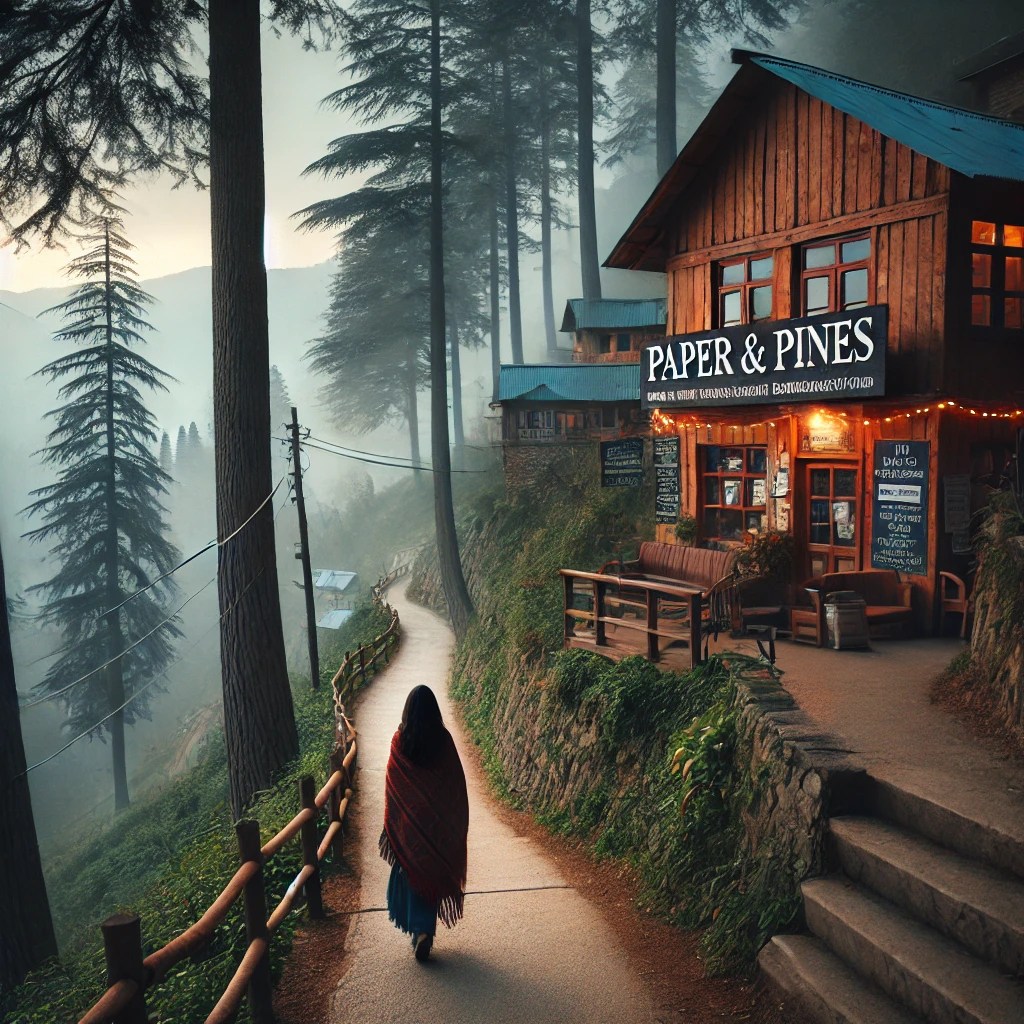
Vaidehi pushed open the heavy wooden door. A small brass bell jingled softly, announcing her arrival. Inside, the scent of brewed coffee, old books, and rain-dampened wood filled the air. The café was warm, a sharp contrast to the chill outside.
Behind the counter, Nachiket sat on a stool, flipping through a tattered novel. He didn’t look up immediately, only flicked his gaze toward her for a second before returning to his book.
“Back again?” he asked, his voice carrying the same low, steady tone she was growing familiar with.
Vaidehi hesitated, her fingers grazing the rough wooden counter. Nachiket. The owner, the barista, the man who spoke little but noticed everything. His presence was like the hills themselves—quiet, solid, unmoving.
“I don’t like unfinished stories,” she said finally, her eyes moving to the bookshelf behind him, where worn-out classics stood beside forgotten paperbacks. She traced the cracked spines of some books with the tip of her fingers.
Nachiket closed his book with an audible thud and leaned forward slightly. “Is that why you’re here? To finish something?”
Vaidehi exhaled, a deep breath that carried more weight than she intended. Tired of pretending she wasn’t running away.
“I don’t know,” she admitted, looking away. “Maybe.”
Nachiket didn’t push. He never did.
Instead, he turned toward the café’s espresso machine, the rhythmic hiss of steaming milk filling the silence. “The usual?” he asked over his shoulder.
“Yeah.” She hesitated, then added, “Extra strong today.”
A ghost of a smirk flickered across his face. “Trouble sleeping?”
“Trouble thinking,” she muttered, rubbing her temple.
He didn’t comment, just poured the coffee into a worn ceramic cup and slid it across the counter toward her. “Thinking is overrated.”
She huffed out a laugh, shaking her head. “Easy for you to say.”
Nachiket only shrugged, already returning to his book.
Vaidehi took her cup and moved toward her favourite spot—the corner table by the window. Outside, the hills stood shrouded in mist, their peaks barely visible. The rain had stopped, but the sky remained heavy with grey clouds, a perfect reflection of the storm she was carrying inside her.

She wrapped her fingers around the warm ceramic cup, taking slow sips, letting the heat ground her.
She was supposed to be writing. An article on solo travel. That was the plan. But instead, she sat there, watching raindrops slide down the glass, watching the world move around her while she remained stuck in one place.
Across the room, Nachiket turned another page, his eyes skimming over the words—but somehow, Vaidehi had the feeling that he saw more than he let on.
A gust of wind rattled the windowpane, carrying with it the faint scent of damp earth and pine needles. Vaidehi sighed, her fingers absently tracing the rim of her coffee cup. She should be working. That was the plan—to come here, sit in this café, and force words onto the blank page waiting on her laptop.
But the cursor still blinked accusingly on the empty screen.
Nachiket flipped another page of his book, the scratch of paper against his fingertips oddly grounding.
She studied him for a moment—his sharp features, the faint stubble along his jaw, the rolled-up sleeves of his sweater revealing tanned forearms. He had the quiet confidence of someone who belonged to the hills, someone who didn’t feel the need to fill silences with unnecessary words.
“You always read the same book?” she asked, breaking the quiet.
Nachiket glanced up, one eyebrow lifting slightly. “What makes you think it’s the same one?”
“You always have a book in your hands, but I’ve never seen you finish one.”
His lips twitched, almost a smirk. “Maybe I like unfinished stories too.”
Vaidehi exhaled a laugh, shaking her head. “That’s a terrible habit.”
“Says the woman who’s been staring at a blank page for three days.”
Her smile faded. “Ouch.”
“Just an observation,” he said, setting his book down. “What’s stopping you?”
She hesitated, staring out the window. “I came here to write about solo travel,” she said, voice quieter now. “About how freeing it is to explore places on your own. How the world opens up when you’re not weighed down by—” She stopped herself.
“By?”
Vaidehi sighed. “By the past.”
Nachiket didn’t pry. He only leaned back against the counter, arms crossed, waiting. It was a patience she wasn’t used to.
She looked down at her coffee, stirring it with her spoon though there was nothing left to mix. “I was supposed to be getting married this year.” The words tasted foreign in her mouth, as if they belonged to someone else.
Nachiket didn’t flinch, didn’t react with pity or surprise. He just nodded, as if she had told him something as ordinary as the weather. “And now you’re here.”
“And now I’m here,” she echoed.
A silence stretched between them, not uncomfortable, just… there.
Finally, Nachiket pushed himself off the counter and walked toward the bookshelf behind her. He ran his fingers along the worn-out spines before pulling out a small, leather-bound book. He placed it in front of her.
She frowned. “What’s this?”
“A travel journal,” he said. “Left behind by a woman who stayed here last winter. She said she wanted someone else to continue the story.”
Vaidehi ran her fingers over the cover, flipping it open to find pages filled with messy, scrawled handwriting, sketches of mountain trails, conversations overheard in cafés, little moments captured in ink.
She swallowed. “And you’re giving it to me because…?”
Nachiket met her gaze. “Because maybe unfinished stories aren’t meant to stay that way.”
Her throat tightened, and for the first time in weeks, the weight on her chest felt just a little lighter.
“Maybe, I can stop running and start again.”, Anany thought
The pages of the journal felt soft, worn down by time and touch. Vaidehi flipped through them, skimming through hurried notes in the margins, lists of places visited, and poetic musings about strangers met along the way. It was messy, unpolished—real.
She ran her fingers over a faded ink blotch on one of the pages, as if tracing the remnants of someone else’s emotions.
“She never came back for it?” she asked, glancing up at Nachiket.
“No,” he said simply, pouring himself a cup of coffee. “She left it with a note—said stories should keep moving, even if people don’t.”
Vaidehi exhaled, shaking her head. “Sounds like something you’d say.”
A ghost of a smirk touched Nachiket’s lips. “Maybe she was a better writer than me.”
She looked back down at the journal, her thoughts swirling. How many people had passed through this town, leaving behind pieces of themselves? And how many, like her, were trying to find a way forward without fully knowing how?
She hesitated before picking up her pen and turning to a blank page. The smooth surface stared back at her, waiting. For a long moment, she simply held the pen in place, feeling the weight of it.
Then, she wrote:

“Day 1: I don’t know if I’m supposed to be writing this, but maybe that’s the point. I came here to forget, but maybe I need to remember first. Maybe healing isn’t about leaving the past behind, but learning how to carry it differently.”
She tapped the pen against the page, reading over her words. It wasn’t much, but it was a start.
Nachiket’s voice pulled her back. “So, what did you leave behind?”
She let out a humorless chuckle. “A life that made sense.”
He leaned against the counter, taking a sip of his coffee. “And does this one?”
She met his gaze. “Not yet.”
He nodded as if he understood. “Good.”
She frowned. “Good?”
“You’re not pretending it does,” he said. “That’s more than most people manage.”
Vaidehi sighed, shaking her head. “You always talk like you know everything.”
“I don’t.” He shrugged. “But I’ve seen enough people come and go from this place to know that the ones who heal don’t always have a plan. They just keep moving.”
She let his words settle.
The café door opened just then, bringing in a gust of cold air and a pair of travelers—backpacks slung over their shoulders, their laughter filling the quiet space.
Vaidehi watched them place their orders, their ease with each other, the way their excitement bounced off the walls. She had once been that person—lighthearted, unburdened, certain of her place in the world.
But certainty was an illusion, wasn’t it?
“Ever thought of leaving?” she asked suddenly. “This town, this café?”
Nachiket didn’t answer right away. He glanced outside, where the hills stretched endlessly, their presence both grounding and suffocating.
“Once,” he admitted. “But then I realized—leaving isn’t always about distance.”
Vaidehi arched an eyebrow. “And what is it about, oh wise one?”
He smirked. “Changing enough that when you come back, you’re not the same person who left.”
She thought about that for a long moment.
Then, before she could overthink it, she turned to a fresh page in the journal and started writing again.
Outside, the sky was still grey.
But it was starting to look like the clouds were beginning to break.
Vaidehi kept writing. It wasn’t neat or poetic, just raw thoughts spilling onto paper. Words she hadn’t said out loud.
“Day 3: I still don’t know what I’m doing here. I tell people I’m working on an article, but mostly, I just walk. I think about the life I left behind, the pieces of it I thought I couldn’t live without. Turns out, I can. It just doesn’t feel like living yet.”
She read the words once, then shut the journal, pushing it aside like a confession she wasn’t ready to face.
Across the counter, Nachiket placed a fresh cup of coffee in front of her without asking.
She smirked. “Do I look like I need caffeine?”
“You look like you need something,” he replied.
She wrapped her hands around the warm ceramic, letting the steam rise into her face. “So, do you always give strangers life advice along with their coffee?”
He leaned against the counter, his expression unreadable. “Not always. Just the ones who look like they’ve lost something.”
Vaidehi let out a dry chuckle. “Great. So I scream ‘lost and broken’?”
Nachiket shrugged. “More like… looking for something you’re not ready to name yet.”
She didn’t respond, just sipped her coffee. Maybe he wasn’t wrong.
The bell above the café door jingled, and an elderly woman stepped in, shaking off the cold.
“Madhu Aunty,” Nachiket greeted, already pouring her a cup of chai.
The woman smiled at him before turning to Vaidehi. “You’re the journalist, right? The one who keeps walking around town, staring at the mountains like they owe her an answer.”
Vaidehi blinked. “I—uh, yeah, I guess that’s me.”
Madhu Aunty chuckled as she took a seat near the window. “Careful, beta. The mountains don’t give answers. They just hold your secrets until you’re ready to hear them.”
Vaidehi glanced at Nachiket, who smirked but said nothing. She shook her head, laughing softly. “Is everyone in this town a philosopher?”
Madhu Aunty sipped her chai. “Only the ones who stay long enough.”
Something about her words made Vaidehi pause. Stay long enough.
She had come here thinking it was temporary, an escape. But was healing supposed to be a short trip? A neat little getaway before returning to life unchanged?
She exhaled, leaning back in her chair. “What if I don’t know what I’m supposed to do next?”
Madhu Aunty smiled knowingly. “Then you do what we all do—wake up, drink chai, and take the next step.”
Nachiket nodded in agreement. “And if that doesn’t work, there’s always coffee.”
Vaidehi shook her head, laughing despite herself.
For the first time in months, she wasn’t thinking about where she had been.
She was thinking about where she was.
And she was starting to feel like maybe that was enough.
—
The End



 Uththan
Leave a comment