Trigger Warning / Disclaimer

This story contains themes of eviction, displacement, socio-political struggles, and activism, which may be sensitive for some readers. It explores economic hardships, urban development conflicts, and the emotional toll of losing one's home or community space. While the story is fictional, it reflects real-world issues faced by marginalized communities.

Reader discretion is advised. If you find such themes triggering, please proceed with caution.
Kiaan adjusted the focus on his camera, capturing the chaotic yet rhythmic motion of Mumbai’s railway bridge at dusk. He preferred the rawness of the streets—real moments, unfiltered stories. The city thrived on movement, and he wanted to bottle that energy in every shot. The rumbling of a passing train, the echo of hurried footsteps, the scent of freshly fried samosas from a nearby vendor—all of it made the moment feel alive.
Just as he angled his camera for another shot, a sharp voice interrupted him.
“Excuse me! You’re in my light.”
Kiaan lowered the camera, turning to see a girl frowning at her sketchpad. She had shifted her stance, trying to avoid his shadow. A crisp white dress clung to her frame, a tape measure draped around her neck like a scarf, and her fingers were smudged with charcoal. Her face was familiar—probably someone from the design college nearby.
He smirked. “Didn’t know the sun was yours.”
She let out an impatient sigh, blowing a stray strand of hair from her face. “It’s not. But I was here first.”
Kiaan glanced around dramatically. “And yet, no ‘Reserved’ sign. A tragedy, really.”
She shot him a glare. “Look, I have a deadline, and you’re literally standing in the worst possible spot.”
“Literally?” He raised an eyebrow. “Pretty sure there are worse places. Like the middle of the tracks.”
Her nostrils flared as she exhaled sharply. “Fine. Let me put it another way—move.”
Amused, he stepped slightly to the side, but his curiosity got the better of him. He leaned in slightly, peering at her sketchbook. What he saw made him pause.
The sketch mirrored the bridge before them—only softer, more intricate. Instead of steel and bolts, she had reimagined it in layers of fabric, threads stretching like suspension cables, delicate yet purposeful.
“A fabric bridge?” Kiaan raised an eyebrow. “That won’t hold up.”
She gave him a flat look. “It’s not supposed to. It’s fashion, not architecture.”
Kiaan crossed his arms. “Bridges are meant to carry weight.”
“And clothes carry people.” She tapped her sketchbook with the end of her pencil. “It’s about connection—how relationships are woven together, even when distance pulls them apart.”
He considered that, tilting his head slightly. “Sounds poetic. But also sounds like something you made up on the spot.”
She scoffed. “You wouldn’t get it. You’re a photographer—capturing things that already exist. I create things from scratch.”
He placed a hand over his heart, feigning offense. “Ouch. So I’m just a glorified copy machine?”
She smirked. “If the camera fits.”
Kiaan chuckled, glancing at her again. “So, your name? Or should I just call you ‘Bridge Girl’?”
“Meher,” she said curtly, snapping her sketchbook shut. “And I need to finish this for my final project, so…”
He held up his hands in surrender. “Right, right. Don’t let me ‘block your light’ again.”
As he walked away, he found himself glancing back at her, drawn to the way her mind wove reality into something almost dreamlike. She didn’t just see the bridge—she reimagined it, unraveled its steel and stone into something softer, more fluid, yet just as strong.
Kiaan had always believed in capturing moments as they were, in their rawest form. But Meher? She wasn’t just documenting the world; she was reshaping it, stitching meaning into every thread and shadow. And for the first time, he wondered if creation and preservation weren’t so different after all—if, in their own ways, they both fought against time, trying to hold on to something before it disappeared.
—
Their paths might have ended there, but fate—or rather, the city—had other plans.
A week later, Kiaan found himself at the local community center, documenting an upcoming demolition. The place wasn’t just a building—it was a second home to many. Struggling artists held workshops here, underprivileged kids learned after school, and migrant workers found a place to rest before heading out for another exhausting day. Now, developers had their eyes on it, promising “progress” in the form of yet another luxury complex.
“This place shouldn’t be torn down,” a voice said firmly.
Kiaan turned, camera still in hand, and saw Meher. This time, she was dressed in a plain blue kurta, sleeves rolled up, clipboard in hand. She stood in front of a group of people—locals, workers, students—explaining something. Behind her, a massive fabric installation of her bridge sketch hung on the community center’s wall, its detailed threads forming interwoven paths.
“You again?” Kiaan smirked. “Didn’t peg you as the protestor type.”
Meher barely glanced at him. “And I didn’t peg you as someone who just watches things fall apart.”
He scoffed. “I document, I don’t interfere.”
She turned to him, arms crossed. “Oh, so when you take photos of broken things, that’s art. But when people fight to stop them from breaking in the first place, that’s interference?”
Kiaan opened his mouth but shut it just as quickly. He looked around—at the kids playing in the dirt, at an elderly tailor adjusting his glasses as he stitched fabric under the dim yellow light, at a young woman explaining her embroidery work to a potential buyer. These weren’t just people. They were livelihoods.
Meher sighed and pulled out a flyer, shoving it toward him. “Look, if you’re just here to collect ‘raw and unfiltered’ shots for your portfolio, then go ahead. But if you actually want to do something useful, come to our meeting tomorrow.”
He took the flyer but didn’t commit. “What exactly is your plan? You think some cloth on a wall is going to stop a bulldozer?”
Meher clenched her jaw. “No, but signatures will. Media attention will. Proving that these people have a legal right to be here will.”
A man in his fifties walked past them, grumbling to himself. “They’ll take our homes just like they took the old marketplace. Said they’d relocate us—still waiting for that miracle.”
A young boy, no older than ten, tugged at Meher’s kurta. “Didi, if they break this place, where will we go?”
Meher knelt down, giving the boy a reassuring smile even though Kiaan could see the exhaustion in her eyes. “They won’t. We won’t let them.”
The boy nodded, but his grip on her sleeve didn’t loosen. Kiaan looked away, uneasy.
He wasn’t an activist. He was just a guy with a camera.
But as he raised his lens again, the stories in front of him didn’t feel like just another project. They felt personal.
“Fine,” he muttered, tucking the flyer into his pocket. “I’ll come.”
Meher blinked, surprised, before recovering. “Good. And bring your camera. If nothing else, at least get the world to see what they’re trying to erase.”
—
The next evening, Kiaan found himself in a dimly lit hall packed with people—workers, students, teachers, and small business owners—all squeezed into the limited space of the community center. A few sat cross-legged on the floor, others leaned against walls covered in old newspaper clippings and handmade posters. The air buzzed with urgency, frustration, and determination.
Meher stood near the front, flipping through a stack of papers. She looked tired, her hair gently falling down her back, ink smudged on the side of her hand from hastily jotting notes.
“You actually came,” she said, barely looking up as Kiaan slid into a spot beside her.
“You did say to bring my camera,” he replied, adjusting the strap on his shoulder.
She gave him a skeptical glance. “Are you here to help or just document?”

Kiaan exhaled, scanning the room. A woman in a faded green saree held a worn-out file in her hands, whispering anxiously to an elderly man. A teenage boy argued with his father about whether staying and fighting was worth the risk. In a corner, a group of kids drew colorful posters, one of which read “Hum yahan rehte hain. Humein mat hatao!” (We live here. Don’t remove us!).
He looked back at Meher. “Haven’t decided yet.”
Before she could retort, a middle-aged man with a thick mustache and sharp eyes stepped forward. He was clearly someone the people respected. “We have three days,” he said. “The demolition team arrives on Friday.”
A murmur spread through the crowd. Some cursed under their breath, others shook their heads in resignation.
“They’re already offering compensation,” another man pointed out. “But we all know how that goes. It’s a fraction of what we’d need to start over.”
Meher straightened. “Then we don’t let them start over. We make sure they don’t get away with another empty promise.”
A woman in her fifties raised a skeptical eyebrow. “And how do we do that, beta? We’ve protested before. Nobody listens.”
“Maybe because you’re not loud enough,” Kiaan muttered.
Meher turned to him. “What do you mean?”
Kiaan adjusted his camera lens, looking around. “A few posters won’t stop a bulldozer. But a story—one that spreads beyond these walls—might.”
The room quieted.
Meher crossed her arms. “And how do you suggest we do that?”
He smirked. “Let me do what I do best.”
—
For the next two days, Kiaan was everywhere—clicking pictures of tailors bent over their sewing machines, street vendors laughing as they prepped their stalls, children practicing dance routines in the open courtyard. He captured their lives in vivid stills—images that made them more than just “people about to be displaced.” They became faces. Stories. Proof of everything this place meant.
Meher, on the other hand, was tireless—talking to lawyers, organizing petitions, calling local journalists who barely returned her messages. She pushed for meetings, stood in the sun collecting signatures, argued with officials who dismissed her concerns.
On the second evening, she found Kiaan sitting outside the community center, reviewing the day’s photos.
“You work fast,” she admitted, sitting next to him.
He glanced at her. “You work harder.”
She laughed lightly. “Comes with the job.”
“You never told me why you care so much,” Kiaan said, shutting his camera.
Meher leaned back against the wall, staring up at the sky. “My dad was a tailor. He had a tiny shop—just two sewing machines and a pile of fabric. It was torn down when I was ten. A builder promised us a new space. We’re still waiting.”
Kiaan exhaled. “So this is personal.”
Meher turned to him, eyes sharp. “Isn’t it for everyone here?”
He held her gaze and, for the first time, didn’t have a smart reply.
—
Friday morning arrived too soon. A line of uniformed officers and demolition workers stood at the entrance of the community centre, waiting for orders. The residents had formed a barricade—Meher among them.
“You can’t do this!” she shouted, shoving a legal document at the officer leading the charge. “We have a stay order!”
The officer barely glanced at it. “Your appeal hasn’t been processed yet. We have orders to proceed.”
Chaos erupted. People yelled, kids cried, elders pleaded. The first hammer struck against the outer wall, and Kiaan’s fingers tightened around his camera.
Meher turned to him, desperation flashing in her eyes. “Now would be a good time to make noise.”
Kiaan didn’t hesitate. He switched to live-streaming, letting the world watch what was happening in real-time. Within minutes, comments poured in. People started tagging news outlets. Journalists who had ignored Meher’s calls suddenly found themselves flooded with notifications.
And then, just as another hammer was about to fall—an urgent phone call came through to the lead officer.
He sighed, signaling his men to stop. “For now.”
The community had bought time. Not much, but enough.
As the crowd slowly dispersed, Kiaan turned to Meher. “So, did we just build a bridge?”
She looked at him, exhausted but determined. “Not yet. But at least we stopped them from burning it down.”
And for the first time, Kiaan knew exactly where he stood.
—
The stay order had bought them time, but time was a fragile thing in a city where power belonged to those with money. By nightfall, rumours spread—bulldozers would return by sunrise, this time with the full force of the authorities. The community was running out of options.
Kiaan scrolled through his phone, checking the live-stream analytics. Views were rising, but the momentum wasn’t strong enough to guarantee a real intervention. He clenched his jaw. Not enough. Not yet.
Meher paced beside him, fingers digging into her arms. “What now? They’ll be back tomorrow, and we can’t stop them with just outrage.”
Kiaan exhaled sharply, staring at the community center wall—at Meher’s massive fabric installation of the bridge. It swayed slightly in the breeze, a fragile but defiant reminder of what was at stake.
Then it hit him.
“You said fashion is about connection, right?” Kiaan asked.
Meher gave him a blank look. “Now’s not the time for a philosophical debate, Kiaan.”
“No, listen. Your bridge—it represents something bigger, doesn’t it? What if we make it even bigger?”
Her frown deepened. “How?”
Kiaan turned the idea over in his mind, then stood abruptly. “You know those huge designer runway shows? The ones where influencers, celebrities, and media show up just to be seen?”
Meher narrowed her eyes. “Yeah, so?”
“What if we turn this into one?”
She blinked. “What?”
“A fashion protest,” he explained. “A show—not in some fancy hall, but right here, on this bridge, with the entire community involved. Models? We have them—tailors, students, vendors. Outfits? Made by the people being displaced. Your fabric bridge will be the runway. We make this place impossible to ignore. We give them a story they can’t look away from.”
For a second, Meher just stared at him. Then, slowly, she started to grin.
“You’re insane,” she muttered.
He smirked. “Yeah, but you love it.”
—
By dawn, the bridge was transformed. Sheets of fabric hung between its iron pillars like banners of defiance. Sewing machines hummed in the open, tailors stitching garments from scraps left behind by broken businesses. Children weaved ribbons into the railings. Volunteers set up makeshift lights, powered by borrowed generators.
And at the center of it all—Meher’s fabric bridge, stretched across the length of the overpass.
Word spread fast. Influencers who lived for controversy arrived first, cameras ready. Journalists followed, intrigued by the unusual protest. Local designers, who once dismissed Meher as just another student, showed up out of curiosity. And then came the unexpected—the city’s elite, some silently supportive, others just desperate to be part of whatever was trending.
By the time the first “model” stepped onto the makeshift runway—a 60-year-old woman in a sari made from old protest banners—the world was already watching.
Each person who walked down that fabric bridge carried a story. A street artist in a jacket stitched from canvas paintings. A tea vendor wearing an apron embroidered with customer names. A young girl in a dress made from torn eviction notices.
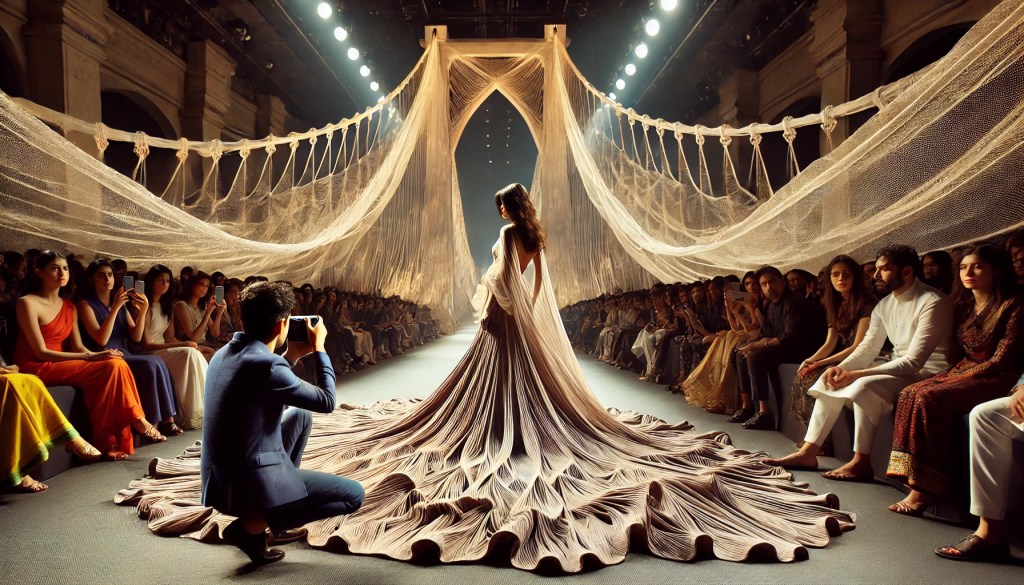
Meher’s design took center stage—a stunning avant-garde piece inspired by the railway bridge. The model walked with poise, the dress flowing like layers of suspended fabric, mimicking the cables of a suspension bridge. Metallic threads shimmered under the spotlight, capturing the essence of strength and fragility. It was a bridge, not just of fabric, but of ideas—of art merging with reality.
Kiaan clicked a shot as the model paused mid-stride. The lines of the dress, the tension of the fabric, the way it seemed to hold its own weight—just like the real bridge, just like the people who crossed it every day.
When Meher joined him after the show, breathless and triumphant, he turned the camera toward her.
“You built a bridge,” he said, showing her the captured image.
She exhaled, the weight of months lifting off her shoulders. “I just hope people see it the way I do.”
“They will,” Kiaan assured her. “They already have.”
Meher stood at the end of the bridge, breath caught in her throat as applause and flashing cameras surrounded them.
And then—just as the city officials arrived, expecting to find an easy demolition site—they found something else instead: a spectacle too big to erase.
—
The police hesitated. Cameras were everywhere. Destroying the place now would mean demolishing a stage filled with models, press, and influencers who could turn this into a national scandal.
The lead officer’s radio crackled. A new order had arrived from higher up.
The demolition was halted.
A collective cheer rose from the crowd. Meher clutched the edge of the fabric bridge, fingers trembling. They had done it. They had forced the city to see them.
Kiaan appeared beside her, camera in hand. “So, now did we build a bridge?”
Meher turned to him, eyes glistening. “Yeah. And this one won’t come down so easily.”
Their fight wasn’t over. But for the first time, they weren’t just defending their home—they were making history.
—
The End



 Uththan
Leave a comment