Trigger Warning / Disclaimer

This story explores themes of political corruption, betrayal, and moral dilemmas. It contains discussions of ethical conflicts, power struggles, and the consequences of exposing the truth

Reader discretion is advised. If you find such themes triggering, please proceed with caution.
The Crossroads of Shadows
The banners snapped against the wind, their fabric stained with dust, Dev Sharma’s face grinning down from every street corner. His name was everywhere—painted across crumbling walls, slapped onto auto-rickshaws, echoing through loudspeakers mounted on old lamp posts. Vikas ki nayi soch! Nyay ki nayi disha! The promises of justice and development rang out over the restless streets, drowning in the honks of cycle rickshaws and the murmur of evening crowds.
Raghav walked through the narrow alleyways, past tea stalls where steam curled up from dented steel kettles, past vegetable vendors swatting flies away from their produce. This was the town he had known since childhood, the place where he had scraped his knees, memorized its rhythms, learned to read between the lines of its politics. But today, the familiarity felt hollow, as if the streets themselves carried a secret he was just beginning to understand.

At a crossroads, a young boy plastered another Dev Sharma poster over a faded one. Raghav paused, watching the child smooth the edges with careful hands, unaware of the irony—the face he was pasting over was Dev’s own, from the last election. A newer version, a sharper image. More polished. More rehearsed.
The thought made Raghav’s throat tighten.
He had believed in Dev. Everyone had.
A privileged son of an influential family, Dev had once stood in these very streets as an outsider—an idealist who rejected his family’s wealth and power to stand with the people. Back then, he had been different. Charismatic, sharp-witted, driven. He had talked about justice, about breaking the cycle of corruption, about giving power back to the people. And Raghav, fresh out of journalism school, had believed every word.
They had spent endless nights arguing over chai in tiny, smoke-filled dhabas, Dev stirring his tea absently as he spoke about change. Power should never cost morality, Raghav. That was what Dev used to say. His voice had been firm, his eyes bright with conviction. Raghav had soaked up every word, written articles that painted Dev as a revolutionary, a leader who would rewrite the town’s fate.
But somewhere along the way, that Dev had disappeared. The speeches still came, the promises were still made—but now, something was missing. A hesitation when questioned about his party’s funders. A carefully worded response when asked about the growing influence of businessmen in his campaign. It was subtle, easy to ignore at first.
Until last night.
Raghav’s grip tightened around his phone, the glow of the screen flickering against his fingers. He scrolled to the photos he had taken—the ones that had shaken him to his core.
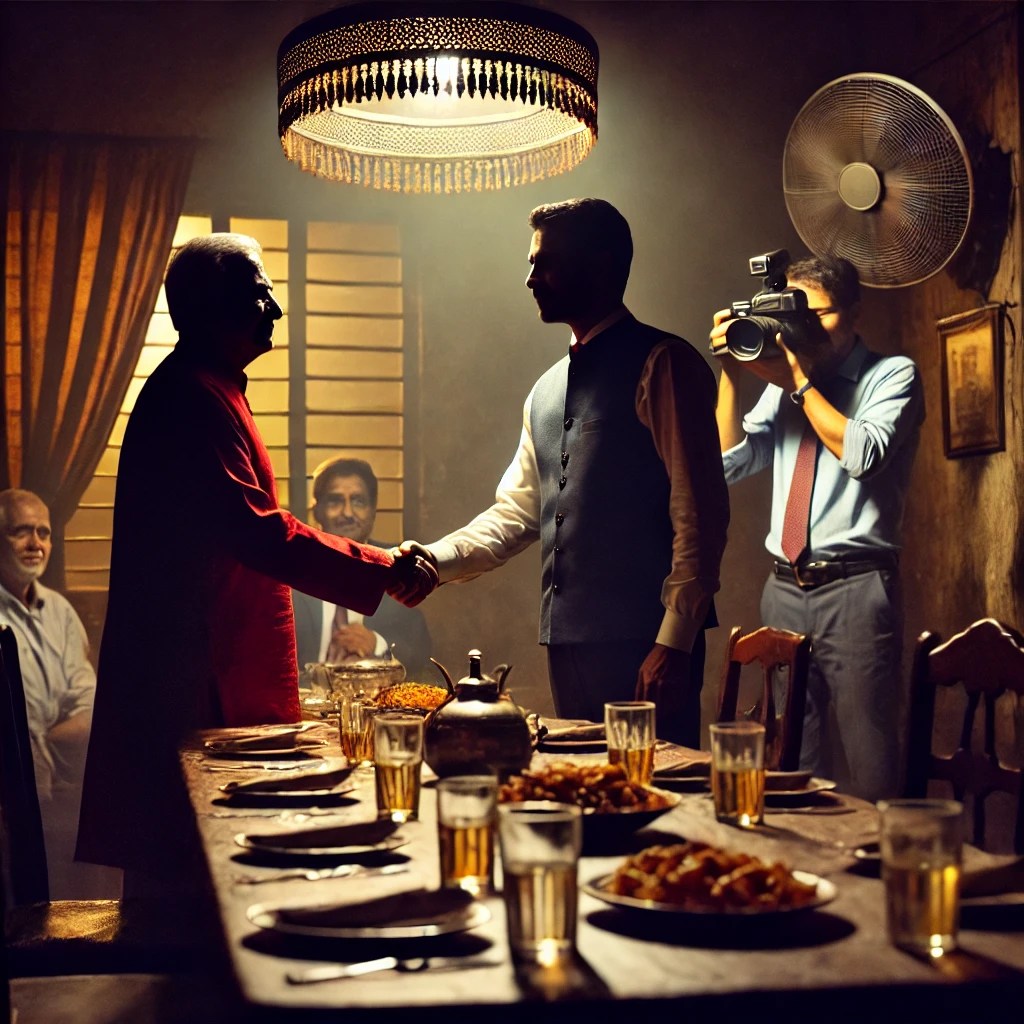
Dev, in a dimly lit restaurant, his expression unreadable, shaking hands with the very men he had once condemned. The men who had drained this town dry, the ones who had funded illegal projects while farmers lost their land. Dev hadn’t just accepted their money. He had promised them power in return.
A deal had been made. A betrayal sealed.
And now, as Raghav stood under the weight of Dev’s looming posters, he realized—this wasn’t just a story. This was a reckoning.
The chai stall at the corner of the market was the same as always—rickety wooden benches, a flickering tube light buzzing with insects, and the familiar scent of ginger and cardamom wafting through the air. Raghav slid onto the bench, his fingers drumming restlessly against the chipped wooden surface.
“Ek cutting dena, Bhaiya,” he muttered, barely looking up at the tea vendor.
The old man grunted in acknowledgment, pouring steaming tea into a small glass. Around him, the stall buzzed with its usual crowd—rickshaw drivers complaining about fuel prices, an elderly man cursing the government’s latest policy, a group of college students arguing over their favorite political leaders. The town lived and breathed politics, and tonight, Dev Sharma’s name was on every tongue.
Raghav lifted the glass to his lips, letting the scalding heat ground him. He needed to think.
The photos on his phone burned into his mind—the handshake, the knowing smiles, the silent agreement sealed over a table littered with half-empty whiskey glasses. Dev had looked so at ease, so certain, as if this was just another step in the journey they had mapped out together.
But it wasn’t.
It was a betrayal.
A familiar voice cut through the noise, jolting Raghav back. “You look like someone just punched you in the gut.”
He turned to see Aditi sliding onto the bench across from him, her sharp eyes scanning his face. She was one of the few people in the newsroom who could match his stubbornness, and maybe the only one who still had faith in him.
“You haven’t blinked in a minute,” she added, stealing his glass of chai and taking a sip.
Raghav exhaled. “I saw something, Aditi. Something bad.”
She arched a brow. “Define bad. Because in this town, ‘bad’ is usually just ‘Tuesday.’”
Raghav pulled out his phone and pushed it across the table. Aditi’s smirk faded as she scrolled through the pictures, her fingers tightening around the device. When she finally looked up, her expression was unreadable.
“When did you take these?”
“Last night.”
She let out a slow breath. “So, Dev Sharma—the man who built his entire image on fighting corruption—is now in bed with the very people he swore to destroy.”
Raghav nodded.
Aditi was quiet for a moment, tapping her nails against the table. “And you’re going to write about this?”
“I don’t know.” The words felt foreign, shameful even. “This isn’t just any story, Aditi. This is Dev. He gave me my first big break. He—he was my friend.”
Aditi leaned forward. “And what about the people who believed in him? The ones who put their trust in a man who stood in the streets and promised them justice? What about them, Raghav?”
He clenched his jaw. He had spent years chasing truth, but now, for the first time, he hesitated. If he published this, Dev’s career was over. His legacy, ruined.
But if he stayed silent?
Then he was just another cog in the machine, another journalist who looked the other way when it mattered most.
Aditi sighed, reaching for the chai again. “You already know what you have to do. You’re just hoping someone will talk you out of it.”
Raghav exhaled slowly. She was right. He did know.
The question was—did he have the courage to do it?
—
The newsroom smelled of old paper, burnt coffee, and ink—familiar scents that had once felt like home to Raghav. But tonight, as he stepped inside, they only made his stomach churn. The ceiling fan creaked overhead, pushing warm air down in slow, lazy circles. The fluorescent lights flickered intermittently, as if undecided about staying on.
He moved to his desk, tossing his bag onto the chair. His laptop sat there, waiting. The cursor blinked on a blank document, taunting him. He had broken stories before—corrupt officials, illegal land deals, even a scandal involving a local police officer. But this?
This was different.
This wasn’t just another politician. This was Dev Sharma.
The memory of their late-night debates over chai and cigarettes clawed at him. Dev, leaning forward, eyes alight with passion. Politics shouldn’t be a dynasty, Raghav. It should be about people like us changing the system from within.
The words felt like a ghost in the air. He clenched his fists.
Aditi dropped a file onto his desk, startling him. “I pulled some records,” she said, brushing her hair back. “Dev’s campaign funds. The numbers don’t add up. There’s a sudden influx of money, all from shell companies linked to—you guessed it—our friends from last night’s meeting.”
Raghav didn’t respond. He didn’t need to. The truth was right in front of him, undeniable, unchangeable.
Aditi sighed. “Raghav, if you don’t write this, someone else will. And they won’t care about the truth. They’ll spin it into whatever narrative benefits them.”
Raghav nodded slowly, his fingers hovering over the keyboard. His mind raced through the consequences. Dev would fight back. He had the money, the influence. And if this story got out, the election wouldn’t just be about policies anymore. It would be a war.
A war Raghav was about to start.
He inhaled deeply and began typing.
DEV SHARMA: THE MAN BEHIND THE MASK
The words felt heavy, but they were honest. And that was all that mattered.
—
Two hours later, the story was done. Facts, sources, the images—everything laid out with precision. He read it once, twice. His hands hovered over the ‘send’ button.
Then his phone buzzed.
Dev Sharma.
The name flashed on the screen, freezing him in place.

For a second, he considered letting it ring. Pretending he hadn’t seen it. But Dev wasn’t the type to call without a reason. And Raghav wasn’t the type to run.
He picked up.
“Raghav,” Dev’s voice was calm, but there was something underneath it—something cold. “Let’s meet. Tonight.”
Raghav’s grip tightened around the phone. “Where?”
“The old tea shop. Same place as always.”
A silence stretched between them, heavy with things left unsaid.
“Come alone,” Dev added.
The call ended.
Raghav exhaled, staring at his laptop screen. His story was ready to go live. The truth, waiting to be unleashed.
And yet, something about Dev’s tone made the back of his neck prickle.
This wasn’t going to be just a conversation.
This was something else.
—
The tea shop was just as he remembered—small, dimly lit, tucked between a paan stall and a tailor’s shop. The scent of boiling chai and fried pakoras lingered in the warm night air. A single bulb flickered overhead, casting long shadows on the cracked pavement.
Dev was already there.
He sat at their usual table in the corner, the one where they had spent countless evenings dissecting politics and power. But this wasn’t the same man Raghav had once known.
Gone was the idealist who spoke of revolution. The man in front of him looked polished, calculated. His white kurta was crisp, untouched by the dust of the streets he claimed to fight for. His watch gleamed under the flickering light. His smile, once effortless, now seemed rehearsed.
“Sit,” Dev said, gesturing to the empty chair.
Raghav didn’t move. “I know about the deal.”
Dev’s smile didn’t falter. Instead, he picked up his cup of chai, taking a slow sip before responding. “You’ve always been a good journalist, Raghav. But this time, you’re looking at the wrong picture.”
Raghav scoffed. “Am I? You promised people change. And now you’re shaking hands with the same men who bled this town dry.”
Dev exhaled, setting his cup down. He leaned forward, his voice quieter now, more controlled. “Tell me something, Raghav. Do you know how many seats my party needs to secure a majority?”
Raghav clenched his jaw. He knew where this was going.
Dev continued, not waiting for an answer. “Politics isn’t about ideals. It’s about survival. You think I wanted to make that deal? I didn’t have a choice.”
“There’s always a choice,” Raghav shot back.
Dev’s expression darkened, the charm slipping. “You still see things in black and white. But the real world is gray, my friend. If I don’t win, someone worse will. Someone who won’t hesitate to burn this town for their own gain. And you’ll have your precious integrity, but at what cost?”
Raghav shook his head. “That’s the same excuse every corrupt politician gives. ‘I’m doing it for the greater good.’ But where does it stop, Dev? Today, it’s just a small compromise. Tomorrow, it’s another. And before you know it, you’ve become the very thing you swore to fight against.”
Dev sighed, rubbing his temple. “I called you here because I respect you, Raghav. Because I wanted to explain. But if you run that story, you won’t just be ruining my career. You’ll be handing this town over to men who don’t care if people starve.”
Raghav’s pulse pounded in his ears. He had expected excuses, justifications—but this? This was a warning.
“You think I’m afraid?” Raghav asked.
Dev’s gaze held his. “I think you should be careful.”
A pause. Heavy. Unspoken things thick in the air.
Raghav pushed back his chair and stood up. “I guess we’ll see, then.”
Dev didn’t stop him as he walked away.
But something about the silence felt more dangerous than words ever could.
—
Raghav walked through the narrow lanes of the town, his mind heavy with Dev’s words. The night was thick with the scent of frying oil and damp earth, the distant sound of a political rally echoing through the streets. Dev’s voice still rang in his ears—calm, certain, almost resigned.
“If I don’t win, someone worse will.”
It was a justification Raghav had heard before. From leaders who had started out as reformers, from men who once swore they would never let power corrupt them. But it always did.
The question was—what was he willing to do about it?
He reached his one-room apartment, a small space cluttered with notebooks, half-read newspapers, and the constant hum of the ceiling fan. His laptop sat on the wooden desk by the window, screen dimmed but waiting.
He hesitated for the first time since getting the story.
Publishing this would destroy Dev’s career. There would be no coming back from it. The party would abandon him, the public would turn on him, and those very businessmen—his new allies—would cut their losses and find someone else to back.
But Dev wasn’t wrong about one thing: the people waiting to take his place were worse. Far worse.
Raghav ran a hand through his hair. His fingers hovered over the keyboard.
His editor, Meera, had been waiting for the article since morning. He knew what she would say if he backed out now. “Truth is truth, Raghav. We don’t get to decide which parts of it are convenient.”
But what if exposing Dev did more harm than good?
A sharp knock at the door startled him. His pulse quickened. It was past midnight—who would be here at this hour?
He moved cautiously, stepping over a pile of books as he reached for the door. He opened it just a fraction.
A man stood in the dimly lit hallway. He was unfamiliar—tall, broad-shouldered, his face shadowed under the yellowing bulb.
“You should drop the story.”
Raghav’s grip tightened on the door handle. “And who are you?”
The man didn’t answer. Instead, he slid a plain brown envelope through the gap in the door. “For your consideration.”
Then he turned and walked away.
Raghav stared at the envelope, his heartbeat loud in his ears. He picked it up with cautious fingers, shut the door, and locked it.
The envelope was thick, heavy. He tore it open and spilled the contents onto his desk.
Photographs. Documents. Evidence.
But not of Dev’s corruption.
Of something far worse.
Dev wasn’t just making political deals—he was being blackmailed. The very businessmen he had shaken hands with had leverage on him. Personal, dangerous leverage.
Raghav felt a chill crawl up his spine.
If he published his article, Dev wouldn’t just lose the election. He might lose everything.
Including his life.
His phone buzzed. A message from an unknown number.
“Choose wisely.”
Raghav swallowed. He was no longer just reporting the truth.
He was caught in the middle of something much bigger.
And now, the choice wasn’t just about integrity.
It was about survival.
—
Raghav sat frozen, staring at the scattered documents. The weight of the moment pressed down on him like a suffocating fog. The dim light from his desk lamp flickered as if uncertain, just like the thoughts racing through his mind. He had spent years chasing the truth, but this—this was no longer just a story. This was a game of power, control, and consequences he wasn’t sure he was prepared for.
His fingers trembled as he picked up one of the photographs. It showed Dev, but not in a boardroom or a campaign meeting. He was at an unmarked, lavish estate, seated across from men Raghav recognized too well. Gangsters disguised as businessmen. The kind of people who didn’t just threaten, but made good on their promises.
Dev wasn’t just making political deals. He was owned.
A gust of wind rattled the old window, making him flinch. His phone buzzed again. Another message.
“Meet me at the old railway yard. Midnight. No one else.”
No name. But he knew who it was.
Dev.
—
The railway yard was abandoned at this hour, except for the distant hum of an approaching train. Raghav stepped cautiously onto the gravel, his breath misting in the cold air. The metallic scent of rust mixed with the lingering stench of old oil. The place was a ghost of the past—forgotten, like so many promises made in this town.
Dev was already there, standing beneath the weak glow of a flickering streetlamp. His face was hollowed with exhaustion, his once-flawless white kurta slightly wrinkled—something unthinkable for the man who had always been meticulously put together.
“You got the envelope,” Dev said, his voice heavy.
“I did,” Raghav replied. He held up the phone. “And the text. What the hell is going on, Dev?”
Dev let out a bitter chuckle, running a hand through his hair. “You already know, don’t you? You’re a good journalist. You figured it out.”
Raghav took a step closer. “Tell me I’m wrong.”
Dev’s jaw clenched. He said nothing.
“So that’s it?” Raghav’s voice rose, anger bubbling up. “You’re just going to let them control you? You—Dev Sharma, the man who once preached about bringing down corruption, are now sitting at the same table as the very people you swore to fight?”
Dev exhaled sharply. “Do you think I had a choice?” His eyes flashed with something raw—desperation, fear, maybe both. “They came to me before I even announced my candidacy. They own this town, Raghav. The land, the businesses, the goddamn law enforcement. You think I could win without their money? Their influence?”
“You could have walked away.”
“And done what? Sat in a newsroom writing about men who don’t give a damn about change?” Dev scoffed. “I had to play their game, Raghav. You don’t understand—”
“I understand perfectly.” Raghav cut him off. “You’re not changing the system, Dev. You’re just making peace with it.”
Silence. Only the distant whistle of the train filled the void between them.
Dev’s hands curled into fists. “You think you’re the only one struggling with this? You think I don’t hate myself every single day for what I’ve become? But it’s bigger than me, Raghav. If I don’t take that seat, someone else will. Someone worse.”
Raghav shook his head. “That’s just another excuse.”
Dev sighed, stepping closer, lowering his voice. “Listen to me. If you publish this—if you expose everything—you won’t just ruin my career. You’ll make enemies you can’t even see coming.” He swallowed. “These people don’t just ruin lives, Raghav. They end them.”
Raghav’s heart pounded. He had known the risks, but hearing it from Dev, seeing the fear in his eyes, made it real in a way it hadn’t been before.
“Don’t do it,” Dev whispered. It wasn’t a threat. It was a plea.
The train roared in the distance, growing louder as it neared.
And in that moment, Raghav knew—this was the crossroads.
If he walked away, stayed silent, Dev would win, and maybe he really would do some good. But he would always be controlled, a puppet dancing to the strings of the same corruption they had once despised.
If he published the truth, Dev’s career would be over. His life might be in danger. But the people deserved to know.
The train thundered past them, dust and wind whipping through the air.
Dev turned away first. “You’ve already made up your mind, haven’t you?”
Raghav didn’t answer.
Because he had.
—
The article went live at dawn.
By noon, the town was in chaos. News channels ran the story nonstop. Protests broke out. Dev’s party distanced itself from him, leaders condemning him, calling him a fraud. The businessmen he had allied with? Silent.
By nightfall, Dev had vanished.
No resignation. No statement. Just gone.
Raghav stared at the blank screen of his phone, waiting for a call that never came. He thought about the last thing Dev had said to him before walking away.
“You’ve already made up your mind, haven’t you?”
Yes, he had.
But at what cost?
The wind howled outside, carrying the echoes of a town that had just woken up to the truth.
—
Days passed, then weeks. Dev’s name faded from the headlines, replaced by the next scandal, the next leader promising change. Raghav’s story had shaken the town, but in the way a stone disturbs the surface of a lake—ripples spreading, then settling, leaving only the memory of the disturbance.
No one knew where Dev had gone. Some said he had fled the country. Others whispered that the same men who had made him had now unmade him. Raghav refused to believe the worst. Dev had always been too smart, too careful. He would survive. Somehow.
But the silence was heavy.
One evening, after another long day at the newsroom, Raghav found himself standing by the riverbank, the same place where, years ago, he and Dev had once talked about changing the world. The air was thick with the scent of wet earth, the distant hum of a prayer bell drifting through the breeze. He lit a cigarette, the ember glowing in the twilight, and exhaled.
“Did we really change anything, Dev?” he muttered to the empty air.
His phone buzzed. A message. Unknown number.
“The truth has a price. Hope you’re ready to keep paying it.”
No name. But he knew who it was.
Raghav let out a slow breath, a wry smile tugging at his lips.
Dev was alive.
Somewhere, in the shadows.
The game wasn’t over. It had only just begun.
—
The End




 Uththan
Leave a comment